This was my second time in Shenzhen. Since I was staying near Yantian Port, I decided to look around nearby Dameisha and also make a trip to Dongmen, which I had long heard was one of the city’s liveliest areas. It was only a little over ten kilometers away by bus.
There is also a place near Yantian called Zhongying Street. The name alone made it sound worth a visit, but getting in requires a permit for the special border management zone, and it is not free, even though it can be handled on the spot. I checked online first to see how the permit worked, then came across descriptions and photos of the street itself. It turned out to be a very short, narrow lane—less than half a kilometer long and not even seven meters wide—so I quickly lost interest.
We went to Dongmen Pedestrian Street that evening. It felt much like the better-known shopping streets in other Chinese cities: a busy commercial area packed with clothing stores and snack stalls. Places like this do not do much for me. I had nothing in particular to buy, and these districts tend to look much the same wherever you go. Before long, we left the pedestrian street behind and headed for Diwang Building. According to what I had read online, it was a place to go up high and take in Shenzhen’s night view.
After relying on phone navigation and taking some time to get there, we finally arrived, only to find that the building did not seem especially tall. We honestly doubted whether it could really offer a view all the way to Hong Kong’s lights. At the ticket counter, admission was 80 yuan per person, and using the telescope cost another 20 yuan each time. It felt too expensive, so we turned around and took the bus back.
The next morning, we planned to go to Dameisha early. But as soon as I got up, I saw that it was raining outside, a light steady drizzle. Since we had already decided to go, we went anyway. The rain was not heavy.
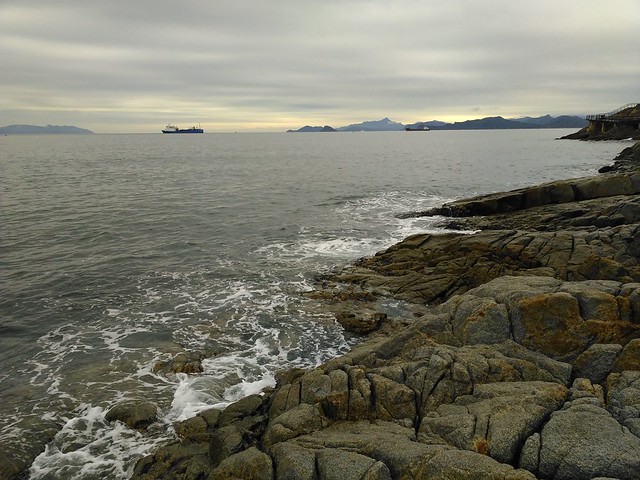
On the way there, the bus followed a coastal road that wound around the hills. Through the window, I could make out the broad sweep of the sea and large rocks lining the shore. That was enough to lift my mood immediately. It reminded me a lot of my first trip to Nan’ao.
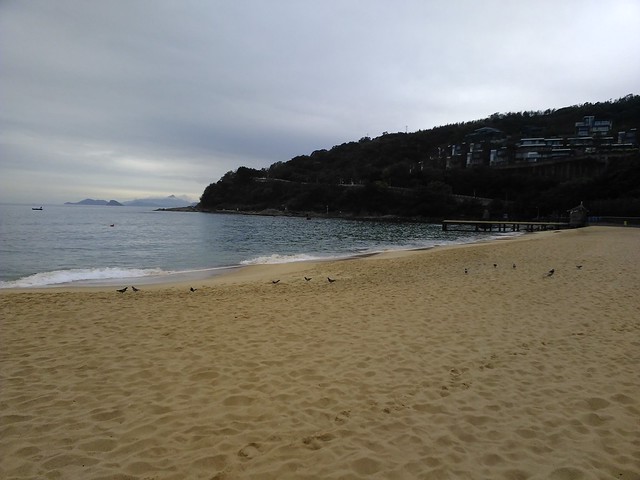
After getting off, we walked to Dameisha Beach. Once on the sand, the place felt somewhat similar to Beishan Bay and Qing’ao Bay in Shantou: low hills on both sides curving around the beach to form a bay. But the beach here was much cleaner, and much larger too.
We walked across the sand under umbrellas, wrote words in the wet beach, and watched the seabirds scattered along the shore.
Before long, we reached the edge of the beach and found a broken pier stretching into the sea. Standing there and looking out, I had the feeling of being surrounded by the ocean. Beyond the pier was a stone-built promenade lined with massive rocks, with waves striking against them again and again. We followed the walkway forward, and it felt as if we were moving deeper into the sea itself.
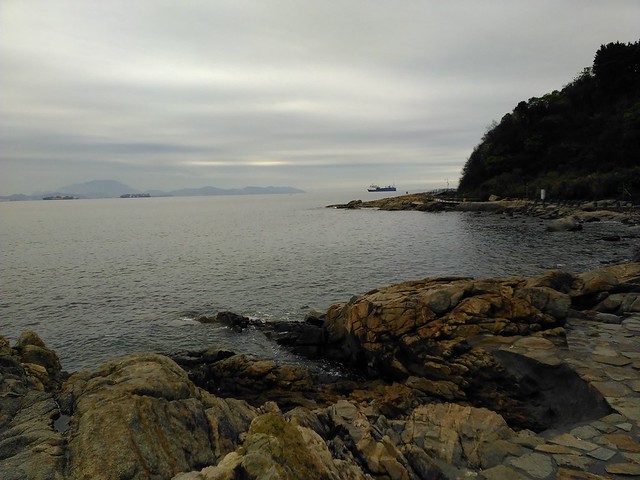
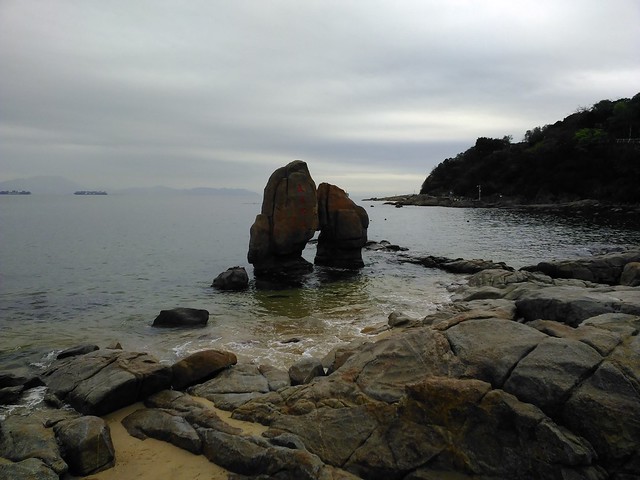
From atop the rocks, I looked toward the distant mountains and thought that must be Hong Kong over there.