All of my stories came from the forests, the fields, the railway lines, from rainbows and the moon. — Kenji Miyazawa
My first encounter with Night on the Galactic Railroad was not through the book itself. I was in high school then, browsing music, when I happened to hear “One Night,” the theme song from the 2006 animated version. The song had a hollow, drifting beauty to it, something airy and distant, and I liked it immediately. Only after looking it up did I realize that it came from a children’s story. At the time I made a firm little plan: after the college entrance exam, I would read the original and then watch the animation.
In the end, laziness won for quite a few years. I did not actually carry out that plan until the winter break of my third year in university.
Night on the Galactic Railroad is not a long fairy tale. While looking for a text online, I ended up with a collection of Kenji Miyazawa’s children’s stories, which also gave me the chance to read some of his other works. That turned out to be a fortunate accident.
Miyazawa’s fairy-tale world is dazzling, clean, and deeply moving. His descriptions of color and landscape have a quality that feels unmistakably his own. Pampas grass about to head is written as “white flames leaping”; the eastern sky first takes on a faint yellow light, then glimmers amber, and finally burns with golden fire, while the hills and fields are covered in shining snow. There are many such passages that made me want to stop and admire them for a while.
At the same time, these stories are not merely beautiful. Their meanings often run deep, sometimes deeper than I could fully grasp on a first reading. There were places where I felt I had only brushed the surface. If I have the chance, I would like to return to them again.
Among the works in that collection, Night on the Galactic Railroad naturally stands out as one of the grandest and most radiant. But the others left strong impressions too. Crossing the Snowfield and The Fourth Day of the Narcissus Month are filled with warmth and goodwill. The Red Mouse, The Cat Office, and Obbel and the Elephant carry sharp satire. The Nighthawk Star is lonely, proud, and heartbreakingly beautiful. I have to admit that my literary grounding is poor, and I cannot express what I felt as well as I would like. Still, Miyazawa’s writing truly has the power to shake something inside me. If someone has not read him before, I would very much recommend giving him a try.
To return to Night on the Galactic Railroad: the story follows the poor boy Giovanni and his closest friend, Campanella, as they journey through the Milky Way on a mysterious train. Along the way, the two boys witness magnificent sights scattered across the universe and meet figures such as the bird-catcher and the little girl, characters who shine with a quiet human warmth.
One of the central concerns of the story is the question of happiness. The episode of “the Scorpion’s Fire” is especially memorable, though I cannot say I accept it without reservation. Through Campanella, perhaps, Miyazawa seems to express one of his own ideals:
For the sake of everyone’s true happiness, I would not mind being burned a hundred times.
It is an intensely romantic ideal. But then, what exactly is “true happiness”? Miyazawa does not define it with any simple clarity. Still, in his own life he seems to have tried to live toward that goal. He devoted himself to education in poor regions, guided agricultural work, promoted literature and the arts, and tried to build the ideal land he imagined. In that sense, he was not merely a dreamer, but an idealist who acted.
Of course, ideals are one thing, reality another. Today, in the twenty-first century, people’s material lives are far better than they were a century ago, and yet suffering still exists everywhere. Why is that? The question is too vast, and I am too dull to know how to begin answering it. I also know my own cowardice. I do not have the courage to give myself so completely to others as Miyazawa did. What I can do is probably only this: keep myself more or less standing, and let whatever small warmth I have reach the few people around me. That is all.
There are also many images in Night on the Galactic Railroad with a religious quality. Religious belief is, of course, a matter of freedom, but personally I cannot say that aspect speaks to me very strongly.
Even after saying these scattered and somewhat directionless things, I truly do admire this fairy tale, and I respect Miyazawa as a person. I am grateful that he created such a clear, brilliant, and refreshing world of imagination. For someone like me, who had lived for more than ten years without reading many fairy tales, it felt like a spring of cold, clean water.
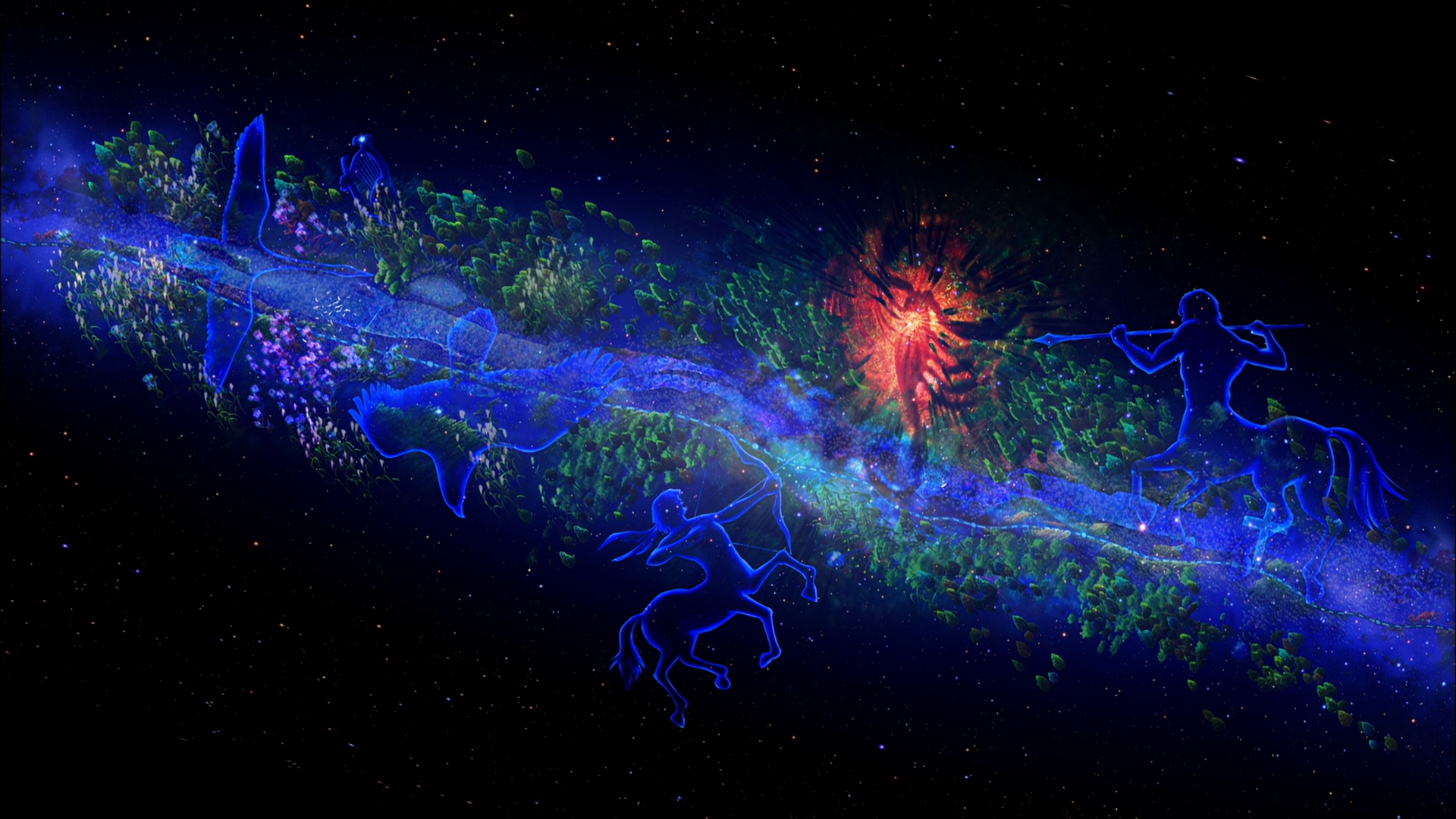
After finishing the story, I watched the 2006 animated version. Judged by today’s standards, this CG work looks somewhat rough. But I imagine that when it first appeared, it must have been quite astonishing. The film gives concrete form to many of the colorful cosmic wonders in the original, and I was moved by the care that Kagaya Yutaka poured into it over three full years. Houko Kuwashima’s voice performance also feels just right. The quiet, ethereal music is the kind that makes one reluctant to leave.
Some viewers have criticized the film by saying that “there are no people in the picture.” I do not entirely agree with that criticism. For one thing, given the CG technology of the time, creating lifelike human figures may have been difficult. For another, the film cuts down the original story and keeps mainly the landscapes of the galaxy. If people had been drawn into those scenes, they might have disturbed the stillness, as well as the loneliness and sorrow that run through the whole work.
Only at the end of the story do we learn that Campanella has died after falling into the water while trying to save a classmate. It is painful to realize, but it also quietly echoes his words and actions aboard the train.
If I were faced with such a situation, what would I do?
I think I already know the answer in my heart. I simply do not dare, or perhaps feel too ashamed, to say it out loud.
These thoughts are disorderly, and my writing is not capable of showing the subtlety and depth of Miyazawa’s work. Nor have I really managed to express my feelings clearly. That is why I can only call them stray thoughts. For now, this is all I can do. When I have time in the future, I would like to look for a complete collection of Kenji Miyazawa’s works and read him more carefully.