A small news item can reveal a much larger pattern. After Shanghai’s Luxun Park reopened following renovations, two groups of elderly exercisers—one practicing tai chi, the other ballroom dancing—ended up in conflict. The immediate cause was simple enough: the park redesign created some new spaces, but on the first day back both long-established groups and newcomers wanted to claim them. People tried to mark off territory with exercise props, bags, newspapers, and whatever else they had on hand. The available space was limited, so friction appeared immediately.
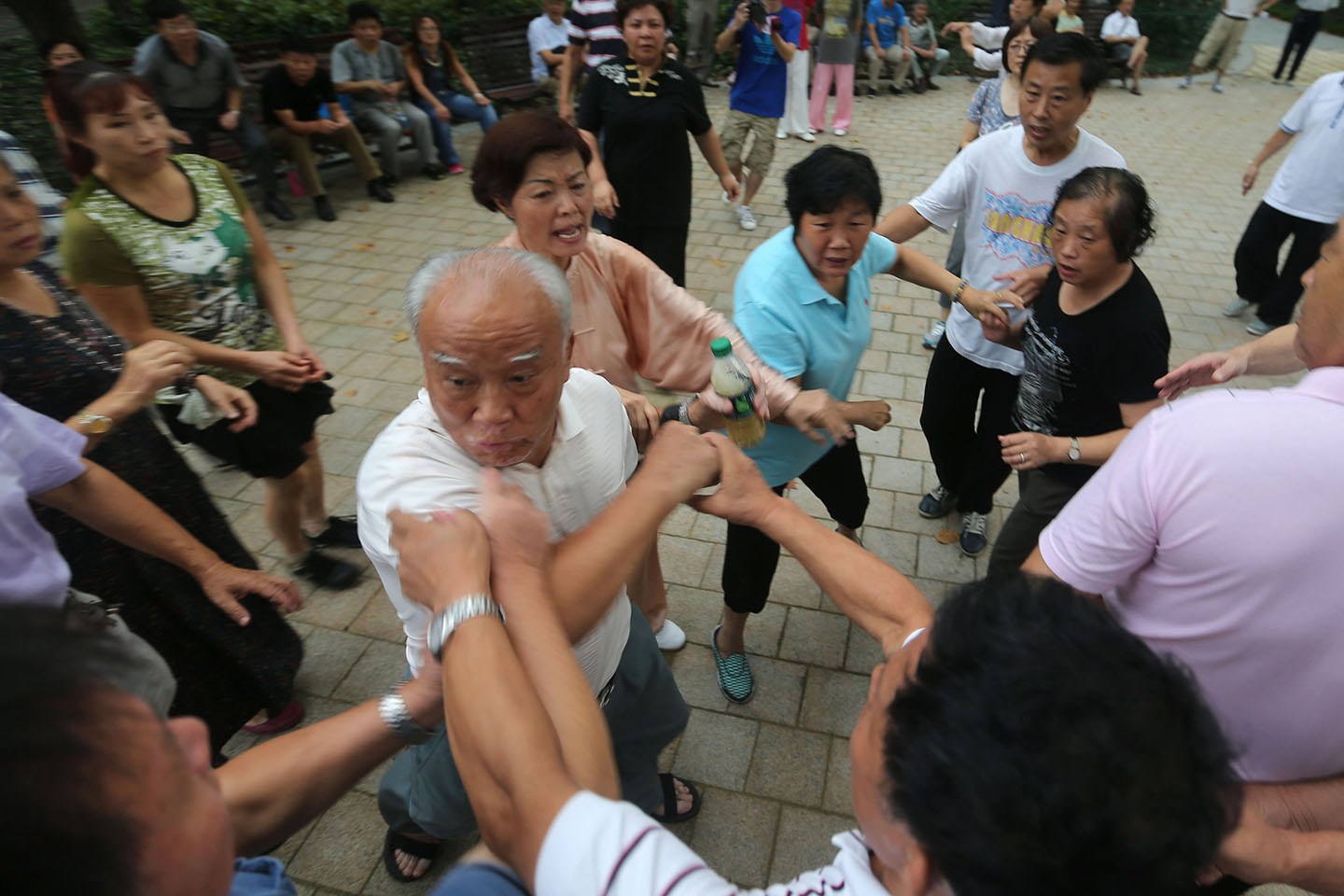
Conflicts like this are everywhere. Some are large and visible, such as the Israeli–Palestinian conflict or tensions between India and Pakistan. Some are much smaller: disputes between neighbors, clashes between sports fans. Some are highly abstract, like conflicts between ideas or values. Others are concrete and immediate, like disagreement over a specific opinion. Some seem distant, such as the tension between a social system and the productive forces developing within it. Others are close at hand, like the relationship between gasoline prices and consumer demand.
Look across all these examples, and two basic features keep appearing.
The first is that the needs or demands of both sides cannot be satisfied at the same time. The second is that there is either no rule capable of coordinating those demands, or the existing rules are no longer strong enough to do so.
Take the Israeli–Palestinian conflict. At that level, the dispute has become a contradiction between political entities, but the root problem is still that both sides claim sovereignty over the same land. Under those conditions, there is no sufficiently powerful rule that can resolve the competing claims without confrontation. The international community can mediate, but mediation is not the same as a final settlement. If the underlying demand remains unresolved, conflict continues.
Something similar existed in ancient China. Northern nomadic peoples often competed over grasslands, and this repeatedly produced clashes between tribes, or between tribes and states. In that historical context, “state” did not mean what it means today. For a long time, individual states existed under the broader framework of “all under heaven.” Their rulers could call themselves kings, but there was only one emperor above them. When conflicts arose between these political units, the emperor’s usual method was coordination.
That coordination often took the form of an imperial decree defining the scope of each side’s interests. If that still failed to stop the dispute, then a more forceful method appeared: the court would station troops nearby and compel acceptance. Whoever refused the settlement could be attacked. In such cases, the emperor’s will functioned as the rule, and military force served as the guarantee that the rule would actually be carried out.
Another kind of conflict runs through history on a much deeper level: the tension between productive forces and social forms. The collapse of slave society is one example. During the Spring and Autumn and Warring States periods, the spread of bronze and iron tools greatly increased productivity. Yet the social order still largely followed the slave-based structures inherited from the Zhou period. Once productivity advanced while the old system remained in place, several major contradictions intensified.
First, land became much more productive than before, and the amount of cultivable land expanded sharply. But under slave society, land belonged to slave owners, while slaves had little incentive to work hard. As a result, the improved productive capacity could not be fully realized, and the land could not generate the wealth it otherwise might have.
Second, nobles did not pay taxes, while small landholders and free commoners did. Since the products of slave labor all belonged to the slave owners, and nobles were the largest slave owners, the result was a wealthy aristocracy alongside a weak state.
Third, the rise of landlords created new interest groups. These emerging elites wanted their own political claims recognized rather than remaining subordinate to the hereditary nobility. Before the Spring and Autumn period, people such as military commanders or large merchants had low standing if they were not nobles. As new economic actors gained strength, they urgently needed independent political rights.
Fourth, the development of commerce and the increase in productivity pushed society toward finer divisions of labor. But slave society lacked enough free people, and that became a major obstacle to social specialization. As productivity continued to improve, these contradictions became sharper and sharper.
What mechanism existed to regulate this? There was no strong legal system in the modern sense. The main restraint was the Zhou ritual order. But trying to preserve an entire social form through ritual alone was clearly insufficient. One noble might condemn another for freeing slaves, but condemnation could not stop tens of thousands of slaves from supporting the person who granted them freedom. Nor could it stop slaves from fleeing toward places where they might become free.
Ritual could preserve a nominal relationship between regional rulers and the Zhou king, but it could not stop warfare and annexation among the states. Once one state swallowed all the others, the inevitable result was the collapse of the old order: “ritual broken, music ruined,” and eventually a new regime replacing the Zhou center. Most importantly, no ritual system could halt the development of productive forces. That process had its own inevitability.
In this contradiction between slavery and rising productivity, Zhou ritual itself was the rule that tried to mediate the conflict. In the end, it could not.
Rules can shape even what seems most instinctive. Crying is a natural human expression. The more grief one feels, the longer one may cry. Yet even this can be disciplined by authority. When Zhu Yuanzhang died, his grandson Zhu Yunwen was eager to secure the throne. He feared that his uncles might use the funeral period to return to the capital and contest the succession, so he did not want them coming to mourn. Custom, however, required at least 49 days of mourning after an emperor’s death. If officials spent all that time lamenting at court, the long interval might create opportunities for trouble.
Zhu Yunwen came up with a solution. Claiming it followed Zhu Yuanzhang’s dying wishes, and presenting it as an act of frugality and consideration for officials, he simplified the funeral: burial after seven days, and officials were allowed to cry only three times. Even those three cries were regulated. A ceremonial officer gave the command. When the officer shouted “Cry,” everyone cried once. When the officer shouted “Stop,” everyone stopped. After three such rounds, it was over. To cry one extra time would be a serious offense. Under the rule imposed by imperial will, and under the intimidation of imperial authority, even grief became rhythmic and controllable.
The same logic appears in ordinary modern settings. If a leader is giving a speech, the audience is expected to applaud at the right moments. That too is a rule. If the leader is speaking passionately and you suddenly start clapping at the wrong time, breaking the flow, that is a problem. If the speech ends, everyone is waiting for applause, and you just stand there looking confused, that is also a problem. In such a setting, the rule exists to coordinate the leader’s needs with your possible noncooperation, and to prevent open conflict from emerging.
Seen this way, many familiar social disputes are easy to understand. Elderly people fighting over exercise space, loud public square dancing that disturbs residents, older passengers slapping younger people over a seat—these are clear cases where there is no effective rule to coordinate competing needs. On the other hand, fraud, corruption, waste, or extorting bribes through official power often occur under conditions where rules already exist on paper, but there is no strong guarantee that those rules will actually be enforced.
When contradictions accumulate, conflict becomes inevitable. That part is hard to avoid. The real question is how to prevent contradictions from piling up in the first place. Refusing to deal with a problem does not eliminate it. Pretending not to see it does not stop it from growing.
Zhu Yunwen could command people to stop crying after three cries, but he still lost the empire. Solving one conflict can easily become the starting point of another. If a contradiction is merely suppressed, if one side’s needs are violently pressed down, the result is likely to be backlash.
The old imperial method of handling frontier disputes through force was simple and often effective in the short term. But once one side in the conflict grew stronger, it would eventually wipe out the weaker side—or, if the central court itself declined, those same forces could turn back and strike the court. The histories of the Tang, Song, and Ming offer many examples of this pattern.
A badly handled conflict can produce a larger one afterward. That later explosion is not simply a matter of the two original sides behaving badly. Often the deeper issue is that the rule used to settle the first conflict was itself defective. Over long stretches of history, one cause leads into another. Things do not change permanently through one violent decision. In the end, durable order depends on working with underlying tendencies rather than trying to overpower them forever.