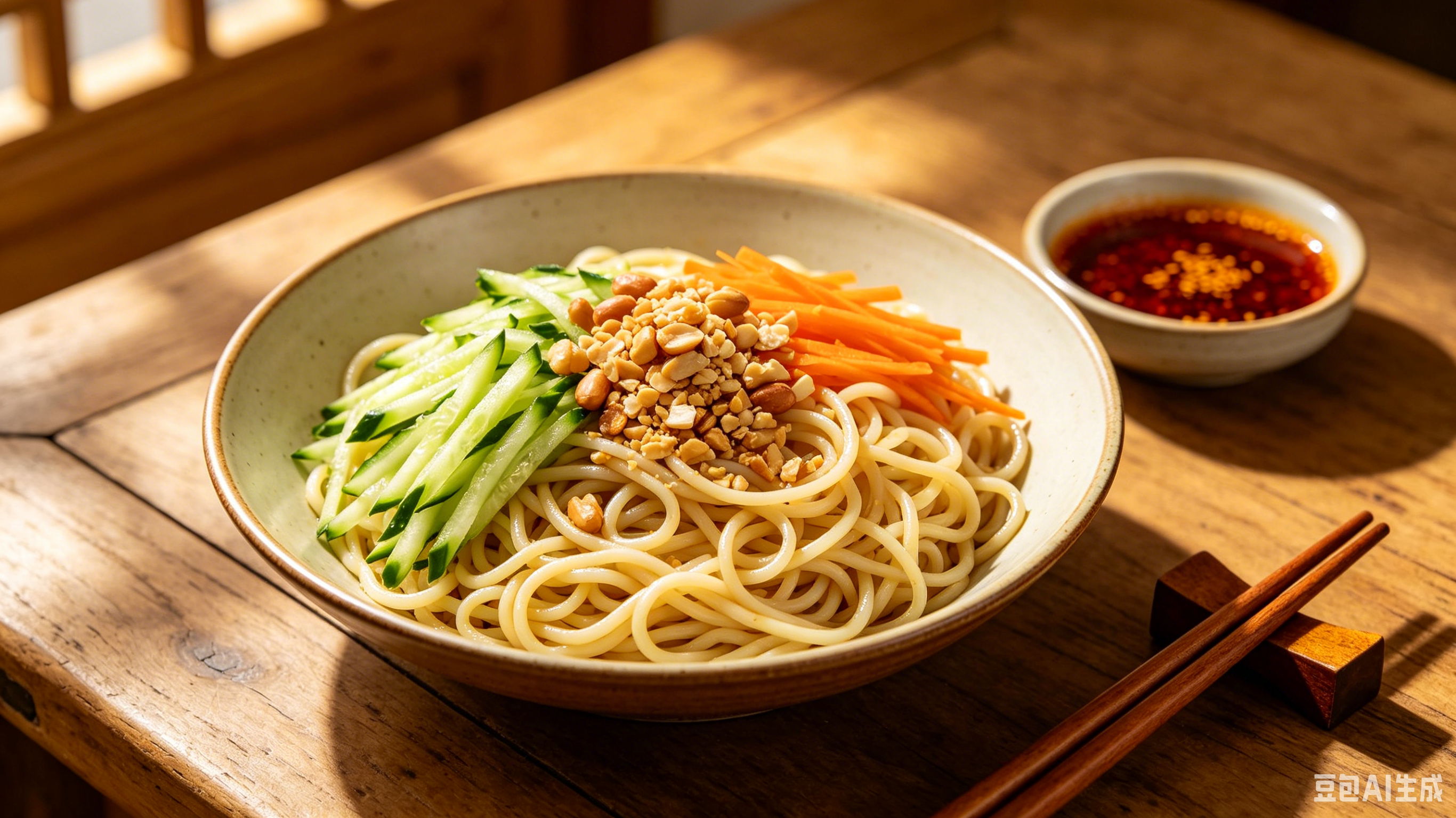
Once summer arrives, cold noodles start showing up on my table again and again.
The method sounds simple enough: cook the noodles, rinse them under cold water, drain them well, then toss them with sesame paste, light soy sauce, vinegar, mashed garlic, a little sugar, and chili oil. Finish with a handful of shredded cucumber and a few peanuts.
When it all comes together, every strand is coated in sauce—light brown, glossy, and slick. It tastes bright without feeling heavy, a little tangy, a little spicy, with that mellow depth from the sesame paste.
This is a combination I arrived at slowly, bowl after bowl. One extra spoonful of sesame paste makes it too thick; one less and it turns watery. A touch too much vinegar and it goes sharp; too little and the flavor falls flat. As for the chili oil, that depends on my mood—when I’m in a good mood I add more, and when I’m not, I add more then too. There isn’t really a fixed standard. There’s only the moment when it feels just right.
One day I made myself a bowl, took a photo, and shared it. A friend commented right away: “That looks so good. Can you send me the recipe?”
I opened the reply box and started typing: two spoonfuls of sesame paste, one spoonful of soy sauce, one spoonful of vinegar...
Then I deleted it.
It wasn’t that I didn’t want to share. It was that I didn’t know how to teach this particular “recipe,” because the taste I was aiming for can’t really be reduced to measurements.
The sesame paste has to be loosened slowly with warm water, stirred in one direction until it turns smooth. The balance of soy sauce and vinegar depends on how thick the sesame paste is. The garlic needs to be freshly pounded, not simply smashed with a knife. The chili oil was made a few days earlier at home, and the oil temperature can’t be too high or it will turn bitter. Those details matter, but they don’t fit neatly into a list of ingredients.
It made me think of my mother’s braised pork. I asked her countless times how she made it, and her answer was always more or less the same: cut the pork belly into chunks, blanch it, caramelize the sugar, add soy sauce, cooking wine, and star anise, then simmer for an hour. But whenever I followed her directions, it never tasted like hers.
I used to ask if she was keeping some secret from me. She always said no. Just add the seasonings in the proper amount.
Later I understood what that meant. “The proper amount” was not a hidden formula. It was something she had learned after making the dish hundreds of times—something her hands knew, her eyes knew, her nose knew, even if she couldn’t explain it out loud.
How much salt to use is not decided by a scale, but by the color of the meat. How long to simmer is not decided by a timer, but by the feel of a chopstick sliding in. Those are not things that can be fully written into steps. You learn them by trying, tasting, adjusting, and doing it again.
Slowly, I found my own sense of that proper amount too. Now when I make cold noodles, I no longer look at a recipe. I pour in the sesame paste and can tell at a glance whether it’s enough. I add the vinegar and can tell from the smell whether it’s too sharp. I take one bite and know whether the bowl has landed where it should.
That is the part I can’t really pass on to a friend. Not because I’m unwilling, but because it doesn’t transfer that way.
So in the end I replied: “I can’t explain it very well. I just go by feel. Come over next time, and I’ll make it for you.”
A lot of things are like that. A mother’s home cooking, a father’s soup, a grandmother’s dumpling filling—so often they come with no real recipe. Not because anyone is holding back, but because the flavor has settled into the hands, into the eyes, into the repetition of doing the same thing day after day. You may not be able to define what “the right amount” is, but your hands know.
I finished mixing the noodles and sat down to eat. Outside, the sun was fierce. Inside, the fan was running, making the noodles in the bowl tremble slightly.
If this bowl of cold noodles has a secret, it is only these two words: just right. And those words never fit inside a recipe card.