In May 2026, the last Model S rolled quietly off the line at Tesla’s Fremont factory in California.
There was no ceremony. No launch event. No farewell spectacle.
Then the teardown began.
Engineers moved in to dismantle the production line that had built Tesla’s most iconic premium vehicles. In its place, Tesla plans to install something very different: a dedicated manufacturing line for Optimus humanoid robots.
That makes the end of the Model S and Model X more than a product decision. It marks a shift in what Tesla seems to believe its next decade will be built on.
Why the Model S and Model X mattered
The Model S was never just another EV.
When it arrived in 2012, electric cars were still widely treated as compromised machines: slow, awkward-looking, limited in range, and suitable mainly for niche buyers. The Model S shattered that image. It brought together blistering acceleration, more than 600 kilometers of range, a giant central touchscreen, and over-the-air software updates in a package that forced the rest of the industry to rethink what a modern car could be.
At its most extreme, it could hit 96 km/h from a standstill in 2.4 seconds. That was the kind of number associated with exotic performance cars, not battery-powered sedans.
The Model X, launched in 2015, pushed the theatrical side of Tesla even further. Its upward-opening falcon-wing doors became one of the most recognizable automotive design features of the past decade. They were also notoriously difficult to engineer and manufacture, and Tesla itself acknowledged how messy production became. But the doors turned the Model X into a symbol. For a time, they helped carry Tesla’s brand premium to its peak.
These were Tesla’s most expensive vehicles, and in many ways its most distinctive ones.
Now both are being discontinued.
Fremont is being repurposed, not retired
Fremont has always carried symbolic weight inside Tesla.
Before Tesla took it over in 2010, it was NUMMI, the long-running joint venture plant operated by General Motors and Toyota. After the acquisition, it became the birthplace of the Model S, Model X, and Model 3. Cars leaving this factory represented Tesla’s original Silicon Valley promise: we are here to disrupt the old order.
Now the site is being reshaped again.
According to Tesla’s plan, the Fremont line will be dismantled and rebuilt within four months, with the factory redirected toward a dedicated production line for Optimus humanoid robots. The stated target is staggering: annual production capacity of 1 million Optimus Gen 3 units.
In the humanoid robotics industry, that number sounds detached from reality.
Even the strongest companies in current humanoid robot manufacturing—among them Unitree in China, Hyundai through its ownership of Boston Dynamics, and 1X Robotics—do not collectively ship anywhere near that scale. Their combined annual output is still below 10,000 units. Tesla is talking about leaping into an entirely different category in one move.
Elon Musk has made wildly ambitious claims before. But this time, Tesla is not just making slides. It is physically taking apart a car factory.
What Optimus Gen 3 looks like today
Before asking whether 1 million units a year is plausible, it helps to look at what Tesla’s robot actually is at this stage.
Optimus Gen 3 is the version Tesla has pushed furthest toward mass-production design. Its published specifications include:
- height: 1.73 meters
- weight: 57 kilograms
- a human-like body scale
- 50 actuators across both hands
- 22 degrees of freedom per hand, enabling tasks such as folding clothes, tightening screws, and sorting parts
- 28 structural actuators across the body for more complex motion chains
- enough battery capacity for an 8-hour work shift on a single charge
- a target retail price of $20,000 to $25,000
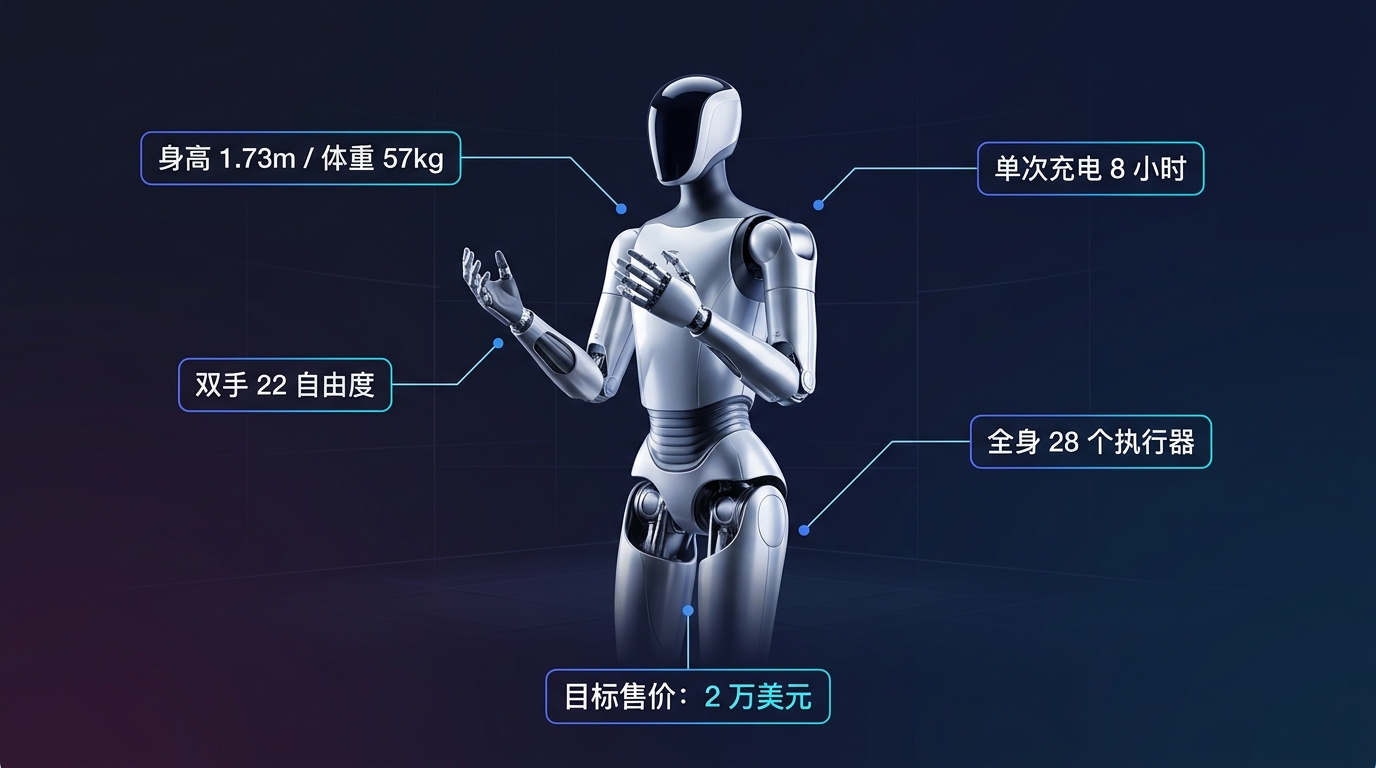
That $20,000 price point is not accidental. It sits roughly in the same territory as the starting price of a Tesla Model 3. The goal appears obvious: make a robot affordable in the way a mass-market car is affordable, so it can be bought, deployed, and used as a labor substitute rather than as a research showpiece.
Tesla has already deployed more than 1,000 Optimus robots inside its own facilities for internal testing. They are being used for part handling, material sorting, and assembly assistance. These are not stage demos. They are tests in live production settings.
That matters. It suggests Optimus has moved beyond concept status.
But there is still a massive engineering gap between a robot that can be used in controlled internal scenarios and a platform that can be manufactured at a rate of 1 million units per year.
Where Tesla stands against Chinese competitors
Humanoid robotics is no longer a field where everyone is waiting for Tesla to make the first serious move. Some Chinese companies have already started shipping units at scale.
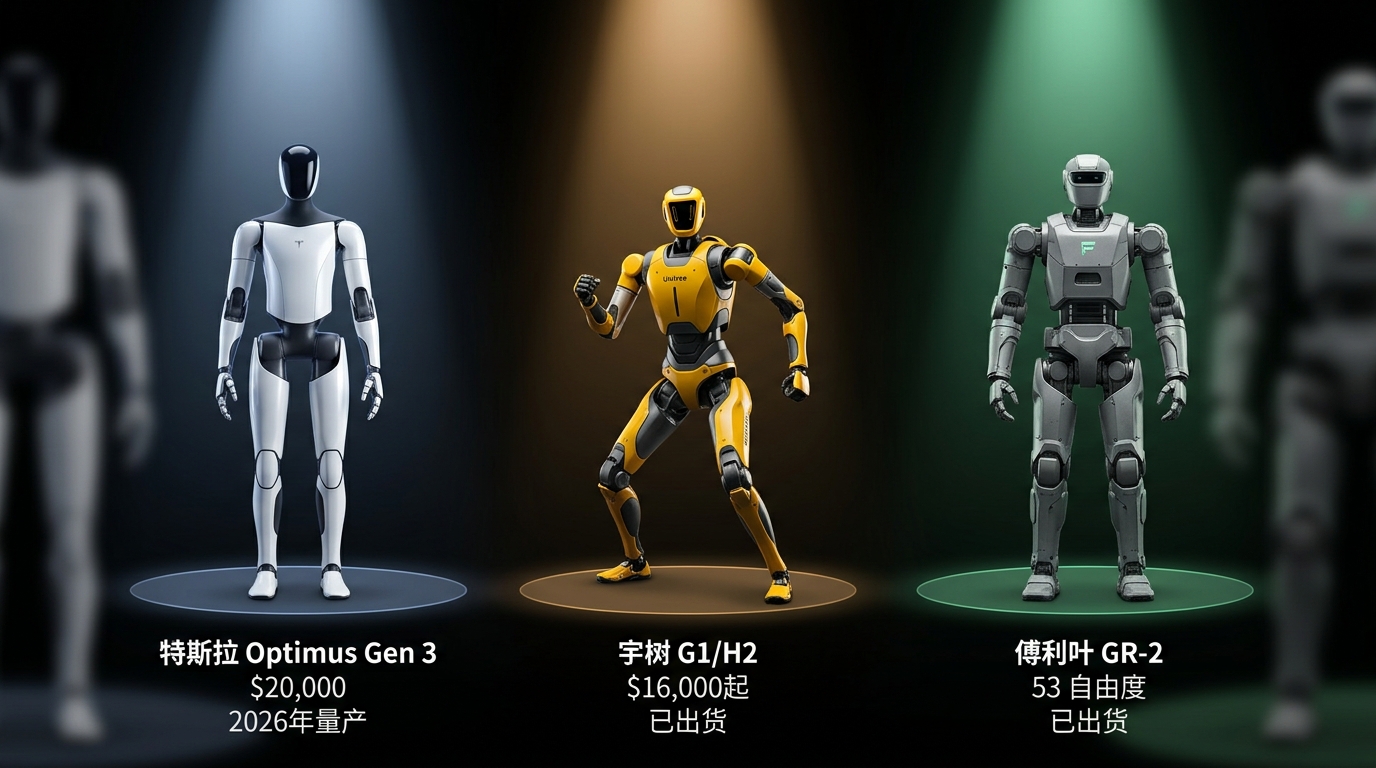
Unitree is currently one of the clearest examples of a company pushing humanoids toward actual commercialization. Its G1 robot is priced at around $16,000 and has already begun shipping to research institutions and industrial customers. The H2, introduced earlier this year as a new flagship, stands 182 cm tall and offers 31 degrees of freedom. Its motion capabilities are already mature enough to attract attention beyond robotics circles. In April, the company’s H1 robot ran in the Beijing E-Town humanoid half marathon at an average speed of 7.51 meters per second, faster than the pace implied by the human 1500-meter world record.
Fourier Intelligence has taken a different path. Its GR-2 offers 53 degrees of freedom, making it one of the highest-DOF humanoid robots publicly available. Its force-feedback joint control gives it a particular advantage in industrial applications, and it has become one of the most frequently cited Chinese humanoid platforms in academic papers.
Xiaomi has also said it plans to deploy humanoid robots across all of its factories within five years. That is not just a concept announcement; it is a supply-chain and integration commitment.
Against these rivals, Tesla’s strengths and weaknesses are unusually clear.
Tesla’s biggest asset here is not necessarily mechanical design.
It is data.
Over the past decade, Tesla’s vehicles have generated billions of kilometers of real-world driving data, which in turn fed the neural networks behind FSD. Tesla appears to be applying the same logic to robots. If 1,000 Optimus units keep working inside factories, the behavioral data they generate can be fed back into future models. That creates a flywheel competitors like Unitree and Fourier do not yet have at the same scale.
The catch is that this flywheel is still mostly potential. It has not fully spun up.
Why Tesla is making the change now
The obvious question is timing. The Model S has been on sale for 14 years. Why shut it down now?
Several pressures are converging at once.
The first is the premium EV market itself. The Model S and Model X were long among Tesla’s most profitable vehicles, but sales began a sustained decline after 2023. Rivals have been eating into that segment from multiple directions: the Mercedes EQS, Porsche Taycan, Xiaomi SU7 Ultra, Zeekr 001, and Luxeed S9 are all targeting buyers who once might have defaulted to a Tesla flagship. In many cases they do so with lower pricing or more localized service advantages. Continuing to allocate manufacturing resources to the Model S and X brings diminishing returns.
The second pressure is capacity. Optimus needs it.
Tesla has never shown much interest in outsourcing the heart of its manufacturing strategy. Musk has consistently favored vertical integration: Tesla builds its own batteries, designs its own chips, and controls its own vehicle production. The same logic appears to apply to robots. If humanoids are central to Tesla’s future, the company wants them made inside its own factories. Fremont is a ready-made industrial asset, and converting it is faster than building an entirely new site from scratch.
The third factor is the window of opportunity.
Competition in embodied AI is accelerating quickly. Nvidia used this year’s GTC conference to announce broader access to Blackwell computing for the humanoid robotics industry. Google, Meta, and Amazon are all increasing their robotics efforts. In China, humanoid robotics has been elevated into a strategic emerging industry. In a market moving this fast, the companies that mass-produce first, collect deployment data first, and establish field networks first may gain an advantage that becomes extremely difficult to reverse.
In the most literal sense, ending Model S and Model X production frees up room for robots.
Can Tesla really build 1 million robots a year?
Honestly, reaching an annual capacity of 1 million units by 2026 looks close to impossible.
But the number itself may not be the main point.
Tesla has often used aggressive targets as a forcing mechanism. The logic resembles the company’s earlier push around Model 3 production goals: set an extreme objective first, then drive the engineering teams, suppliers, and production systems toward it as hard as possible. The final result may fall far short of the headline figure—perhaps 50,000 units, perhaps 100,000—but the process still generates valuable manufacturing knowledge.
That matters especially in robotics, where the contest is not only about how many units get sold. It is also about who can deploy enough machines in real environments to gather meaningful data at scale.
If Tesla ends 2026 with 50,000 Optimus units operating inside its own factories, and sells 100,000 in 2027, that alone could be enough to create a data moat competitors would struggle to copy.
Seen from that angle, the end of the Model S and Model X is not mainly a financial decision. It is a strategic wager.
Tesla seems to be betting that its next decade will depend less on selling cars and more on selling robots.
Whether that bet is right probably becomes much clearer in 2027.
A line is disappearing, and another idea is taking its place
The falcon-wing doors of the Model X may be one of the most recognizable pieces of automotive design from the last ten years.
For a long time, they felt like a concept-car flourish that somehow escaped into the real world. Then they survived mass production, stayed on the market for a decade, and became part of Tesla’s visual identity.
Now that production is ending, and the line that built them is being turned into a humanoid robot factory.
A decade from now, Optimus may look the way the falcon-wing doors once did: something that initially seemed like an indulgent concept, only to end up changing a real industry.
Or it may not.
Either way, this is no longer just an idea on a presentation slide. Tesla has started by tearing out the line.