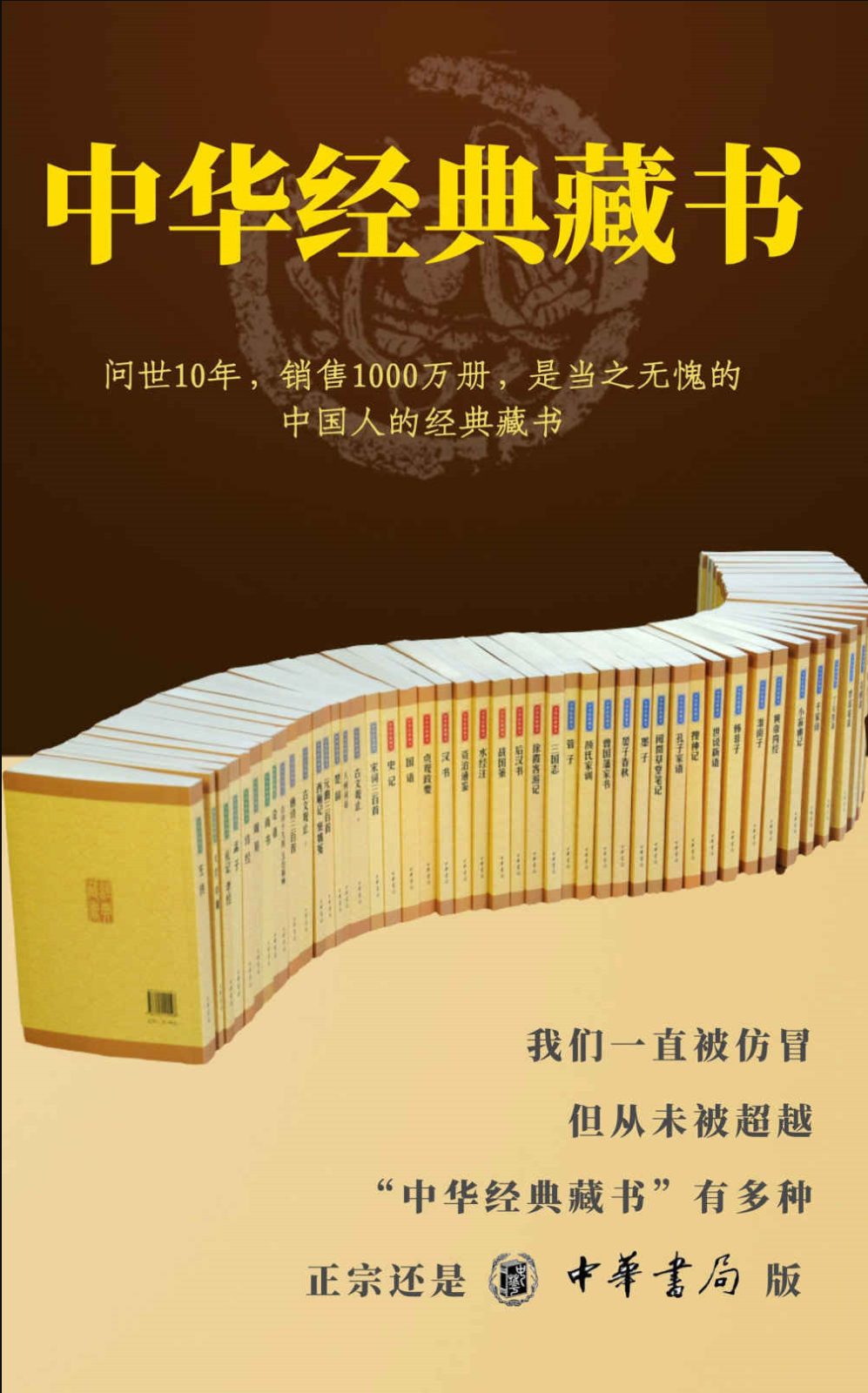
Zhonghua Book Company's Chinese Classics Library is built around a simple idea: the value and charm of the classics do not fade with time, and the wisdom of the sages still has something to say to modern life. The series is meant to be a bridge between ancient texts and present-day experience. It runs to sixty-one volumes and gathers canonical works from the Four Books and Five Classics, the masters, histories, poetry, fiction, military texts, medicine, and daily-life writing. The arrangement follows broad fields rather than a strict chronological line, which makes the set feel like a reading map rather than a monument.
The sixty-one volumes include paired works in single volumes and at least one two-volume title, so the count of volumes is not the same as the count of titles. The five divisions below are the practical shape of the collection.
Language and literature
- Book of Songs (Shijing) — China's first anthology of poetry.
- Songs of Chu (Chuci) — the source of China's romantic poetic tradition.
- Nineteen Old Poems and New Songs from the Jade Terrace — the former is an ancestor of the five-character poem; the latter is the first poetry anthology to include the long narrative poem The Peacock Flies Southeast.
- In Search of the Supernatural (Soushen Ji) — China's earliest collection of supernatural tales.
- A New Account of Tales of the World (Shishuo Xinyu) — China's earliest collection of anecdotes about notable people.
- Three Hundred Tang Poems — the most widely circulated Tang poetry anthology since the Qing dynasty.
- Three Hundred Song Ci Poems — still regarded as one of the best anthologies of Song ci.
- Three Hundred Yuan Qu Songs — one of the best readers for Yuan qu.
- Romance of the Western Chamber and Injustice to Dou E — the first is paired with Dream of the Red Chamber as a twin jewel of classical Chinese literature; the second is one of China's ten great tragedies.
- Strange Tales from a Chinese Studio (Liaozhai Zhiyi) — the high point of classical Chinese short fiction.
- Notes from the Yuewei Hermitage — paired with Liaozhai as the twin jewels of Qing fiction.
- Guwen Guanzhi (two volumes) — the best anthology for learning classical Chinese prose.
- Three Character Classic, Hundred Family Surnames, Thousand Character Classic, and Standards for Students — the most widely spread elementary classics, known together as San Bai Qian Di.
- Poems of a Thousand Masters — a widely used elementary poetry reader in premodern China.
- Renjian Cihua — the most celebrated modern work of ci criticism.
History and geography
- Book of Documents (Shangshu) — China's first history organized as recorded speeches.
- Discourses of the States (Guoyu) — the first state-by-state history.
- Zuo Commentary (Zuozhuan) — the first chronological history with detailed narrative.
- Annals of Master Yan (Yanzi Chunqiu) — records the words and deeds of the Spring and Autumn statesman Yan Ying.
- Strategies of the Warring States (Zhanguo Ce) — a state-by-state history of the words and activities of Warring States strategists.
- Records of the Grand Historian (Shiji) — the first comprehensive biographical history.
- Book of Han (Hanshu) — the first dynastic biographical history.
- Book of the Later Han (Hou Hanshu) — a biographical history of the Eastern Han.
- Records of the Three Kingdoms (Sanguozhi) — the authoritative history of the Three Kingdoms.
- Comprehensive Mirror in Aid of Governance (Zizhi Tongjian) — the first chronological comprehensive history.
- Classic of Mountains and Seas (Shanhai Jing) — an ancient wonder book rich in myth.
- Commentary on the Waterways Classic (Shuijing Zhu) — a comprehensive geography with considerable literary flair.
Philosophy and religion
- Book of Changes (Zhouyi) — the first of the classics, a philosophical source.
- Book of Rites and Classic of Filial Piety — the former is a collection of Confucian essays on ritual; the latter is the theoretical basis for governing by filial piety in antiquity.
- Analects — often called the Chinese Bible.
- Mencius — the classic recording the thought of the 'Second Sage'.
- Great Learning and Doctrine of the Mean — the former sets out the Confucian path of cultivating the self, regulating the family, governing the state, and pacifying the world; the latter is the Confucian way of 'attaining centrality and harmony' in dealing with the world.
- Laozi — the founding work of Daoist philosophy.
- Mozi — representative work of the pre-Qin Mohist school.
- Family Sayings of Confucius (Kongzi Jiayu) — the first book for Confucius studies.
- Guanzi — an important work on the words and thought of Guan Zhong.
- Book of Lord Shang — an important record of the reformer Shang Yang's thought.
- Liezi — a remarkable Daoist work.
- Guiguzi — representative of pre-Qin Vertical and Horizontal strategists.
- Zhuangzi — the most literary of philosophical works.
- Diamond Sutra, Heart Sutra, and Platform Sutra — three core classics in Chinese Buddhist history.
- Earth Store Sutra and Medicine Buddha Sutra — the first is the 'filial piety sutra' of the Buddhist canon; the second is a classic for seeking relief for the sick and suffering.
- Zeng Guofan's Family Letters — letters showing Zeng Guofan's pursuit of cultivating the self, regulating the family, governing the state, and pacifying the world.
- Xunzi — the culmination of pre-Qin Confucianism.
- Han Feizi — the culmination of pre-Qin Legalism.
- Lüshi Chunqiu — representative of pre-Qin eclectic thought.
- Huainanzi — a Daoist representative work that bridges eras.
- Family Instructions of Master Yan — the ancestor of family instructions ancient and modern.
- Quiet Notes from a Small Window — a guide to conduct and finding one's place, one of the three remarkable books on dealing with the world.
- Caigentan (Vegetable Roots Discourse) — fundamental wisdom about life, one of the three remarkable books on dealing with the world.
- Night Talks by the Stove — aphorisms on conduct, said to have been 'roasted out over sweet potatoes', one of the three remarkable books on dealing with the world.
- Four Lessons of Liaofan — a sincere and earnest exhortation to the world.
- Travel Diaries of Xu Xiake — the travel diary of a Ming dynasty traveler.
Politics and military affairs
- Treatise on Personalities (Renwu Zhi) — ancient China's monograph on distinguishing and appraising talent.
- Essentials of Government of the Zhenguan Era — a famous summary of the historical experience of Emperor Taizong's Zhenguan governance.
- Art of War and Thirty-Six Stratagems — the first is China's earliest extant military book, honored as a 'sacred classic of military science'; the second collects thirty-six ancient Chinese military schemes.
- Six Secret Teachings — the culmination of pre-Qin military thought.
Science and daily life
- Yellow Emperor's Inner Canon — the originating text of traditional Chinese medicine.
- Dream Pool Essays — a milestone in Chinese scientific history.
- Classic of Tea and Suiyuan Menu — the first is an ancient Chinese encyclopedia of tea; the second is the gastronomic list of a gifted scholar.