Manufacturing R&D planning has little in common with a generic software sprint. A materials program may spend a year proving a formulation, then another year learning whether it can be mixed, coated, sintered, or rolled at a scale that makes commercial sense. A process program may look stable in the lab and fail on the first production line because a parameter window was never mapped. The plan has to connect materials science, process engineering, equipment, quality, procurement, and production before the first experiment begins.
The constraints are real. Development work crosses disciplines. Timelines run from months to years. Equipment, talent, and trial runs are expensive. Quality and safety requirements are strict, and customer validation can be unforgiving. Supply chains add another layer: raw material suppliers, equipment vendors, and downstream customers all affect whether a technical result becomes a product. A useful plan is not a beautiful Gantt chart. It is a working instrument for making decisions when experiments disappoint, equipment is unavailable, or a key supplier slips.
Start with the constraints that shape the plan
Materials development and process development need different planning logic, even when they sit inside the same program.
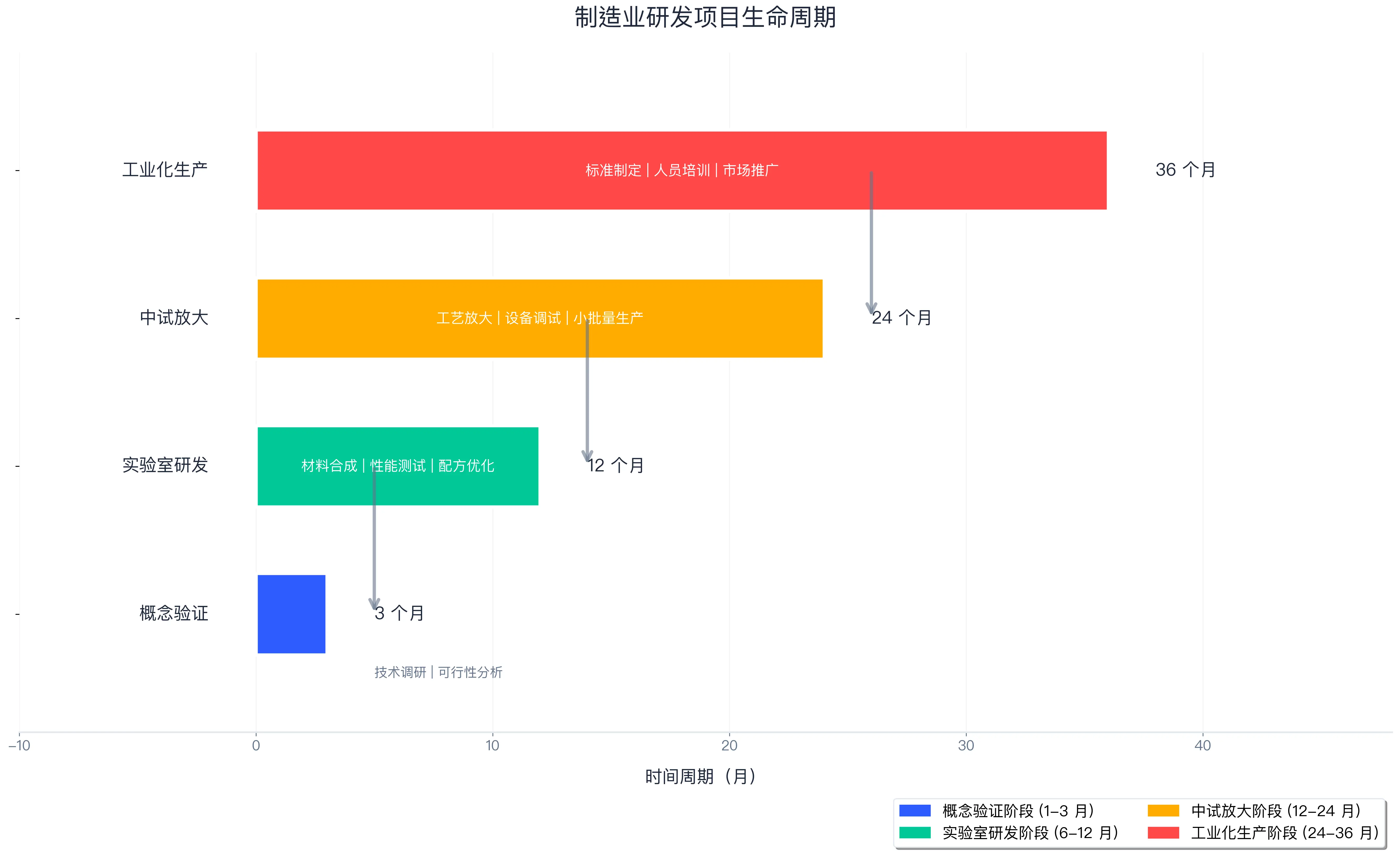
Materials work usually moves through concept validation in one to three months, laboratory R&D over six to twelve months, pilot scale-up over twelve to twenty-four months, and industrial production over twenty-four to thirty-six months. The plan should define the technical roadmap: performance targets, synthesis routes, characterization methods, and the evidence that will prove a material is ready to move forward. Resource planning covers equipment needs, raw material purchasing, and lab space. Risk assessment looks at technical feasibility, supply stability, and intellectual property. Milestones should be tied to measurable performance, patent filings, and sample preparation rather than to activity alone.
Process development answers a different question: how does a lab result become a repeatable, scalable production process? The sequence typically runs from process parameter optimization to equipment selection or modification, process validation, and standard operating procedures. The planning core is the process window: the range and tolerance of critical parameters. The team also needs an equipment capability assessment, a quality control plan with inline inspection, offline analysis, and statistical process control, plus a cost-benefit analysis covering return on investment, production cost, and market competitiveness.
The planning spine: eight elements and four moves
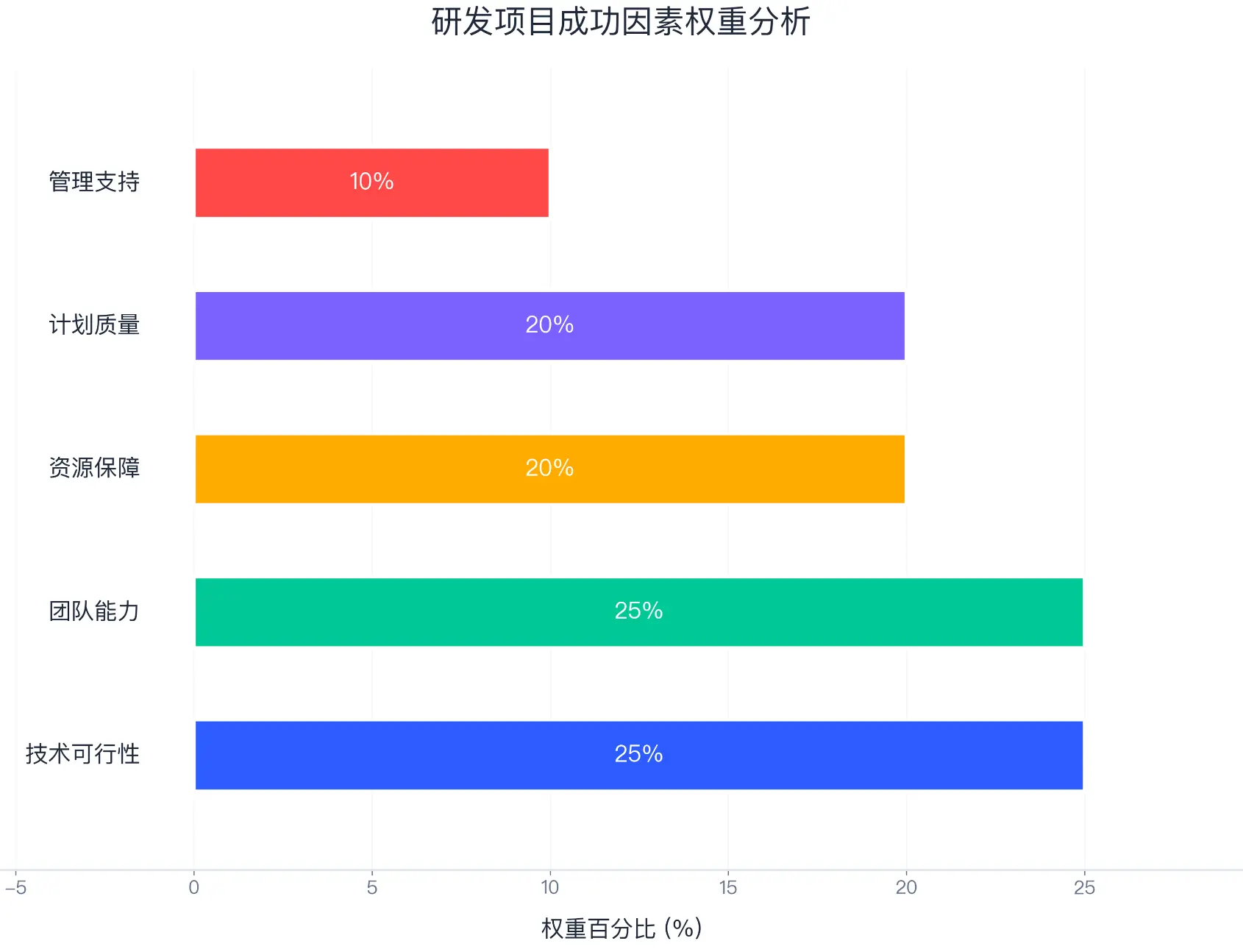
A manufacturing R&D plan needs eight connected elements: project goals and scope, technical route and solution, resources and budget, time and milestones, risk management, quality control, team organization and responsibilities, and communication and reporting. These are not separate appendices. They are the spine that keeps technical work, business targets, and execution rhythms aligned.
The first move is demand analysis and target setting. Market demand should be grounded in customer needs, competitor analysis, and technical trends. Technical targets cover performance, cost, and quality. Commercial targets cover market share, return on investment, and strategic value. A plan that lists only technical targets will struggle to justify resources when the first technical obstacle appears.
The second move is a work breakdown structure. For a new-energy vehicle battery materials program, a workable breakdown might look like this: project initiation and planning; material design and screening, including cathode development, anode development, and electrolyte formulation; process development and optimization, including synthesis, forming, and post-treatment; performance testing and validation; and industrialization preparation. The breakdown does not need to be elegant. It needs to expose the work that must be estimated, staffed, and reviewed.
The third move is time planning and critical path management. A Gantt chart is useful, but the critical path matters more. The team should identify activities that directly control total duration, manage float on non-critical work, and set milestones that mark real acceptance points. A milestone that only says a meeting happened is not a milestone.
The fourth move is resource and budget planning. Human resources include R&D staff, engineers, and technical workers. Equipment includes lab instruments, pilot equipment, and production equipment. Materials include raw materials, reagents, and consumables. The budget should separate R&D expenses, equipment investment, and operating costs. Resource planning is also a negotiation: the plan should show what is needed, when it is needed, and what happens if it is not available.
Team structure is part of the plan, not an afterthought
A manufacturing R&D program usually needs a steering committee for strategic decisions and resource coordination, a materials R&D team for new material development and performance optimization, a process engineering team for process and manufacturing optimization, and a test and validation team for performance testing and quality verification. A project coordinator sits across these groups to handle daily management, progress tracking, and cross-department coordination. The structure should make it clear where technical decisions are made and where execution decisions are made.
The operating rhythm matters as much as the org chart. A daily fifteen-minute stand-up can synchronize progress and surface blockers. A weekly technical review gives the team room to debate test results, technical routes, and trade-offs. A monthly project review reports progress to management and adjusts resources. These meetings should have different purposes. If every meeting becomes a status report, technical problems will not get the attention they need.
Knowledge management is another part of execution. Technical documentation should be standardized: experiment records, process files, and test reports. A lessons-learned database should capture successful cases, failure analysis, and improvement suggestions. A mentoring system lets senior engineers transfer skills to newer staff. Without these habits, a team can repeat the same experiment six months later and call it progress.
Incentives should align individual goals with project and team goals. Innovation results and technical breakthroughs should be recognized promptly. Technical sharing sessions, cross-department exchanges, and team activities help reduce the isolation that often grows between materials, process, and test groups. Recognition does not replace resource planning, but it affects whether people share bad news early enough for the plan to respond.
Monitoring should use a small set of working tools: a project dashboard showing progress, quality, and cost; a risk register tracking risk status and response actions; a change control process for requirement changes; and a performance evaluation system based on outcomes for teams and individuals. The dashboard should be reviewed in the same rhythm as technical work. Otherwise it becomes a reporting artifact rather than a management tool.
A worked example: superalloy for turbine blades
The project goal is a new high-temperature superalloy for aircraft engine turbine blades. The technical requirement is a fifteen percent improvement in temperature resistance and a ten percent cost reduction.
In the first month, the team defines a target matrix. Technical targets include temperature resistance of at least 1150°C, creep life increased by twenty percent, and oxidation resistance increased by thirty percent. Commercial targets include cost at or below ninety percent of the current material, a ten percent market share, and at least three patents. Time targets include completion in twenty-four months, quarterly milestones, and monthly technical reviews.
In months two and three, the team builds the detailed plan. A resource table might look like this:
<table> <thead> <tr> <th>Resource</th> <th>Number</th> <th>Owner</th> <th>Timing</th> </tr> </thead> <tbody> <tr> <td>Materials scientists</td> <td>3</td> <td>Dr. Zhang</td> <td>Full project</td> </tr> <tr> <td>Metallurgical engineers</td> <td>2</td> <td>Engineer Li</td> <td>Months 4–18</td> </tr> <tr> <td>Test engineers</td> <td>2</td> <td>Engineer Wang</td> <td>Months 6–24</td> </tr> <tr> <td>SEM equipment</td> <td>1</td> <td>Equipment department</td> <td>Months 3–22</td> </tr> <tr> <td>Heat treatment furnaces</td> <td>2</td> <td>Equipment department</td> <td>Months 5–20</td> </tr> <tr> <td>Total budget</td> <td>5 million</td> <td>Finance department</td> <td>Quarterly release</td> </tr> </tbody> </table>From months four to twenty-four, execution and monitoring use four KPI groups. Technical KPIs include material performance compliance and test success rate. Schedule KPIs include on-time milestone completion and task delay rate. Cost KPIs include budget execution and cost savings. Quality KPIs include test data accuracy and document completeness.
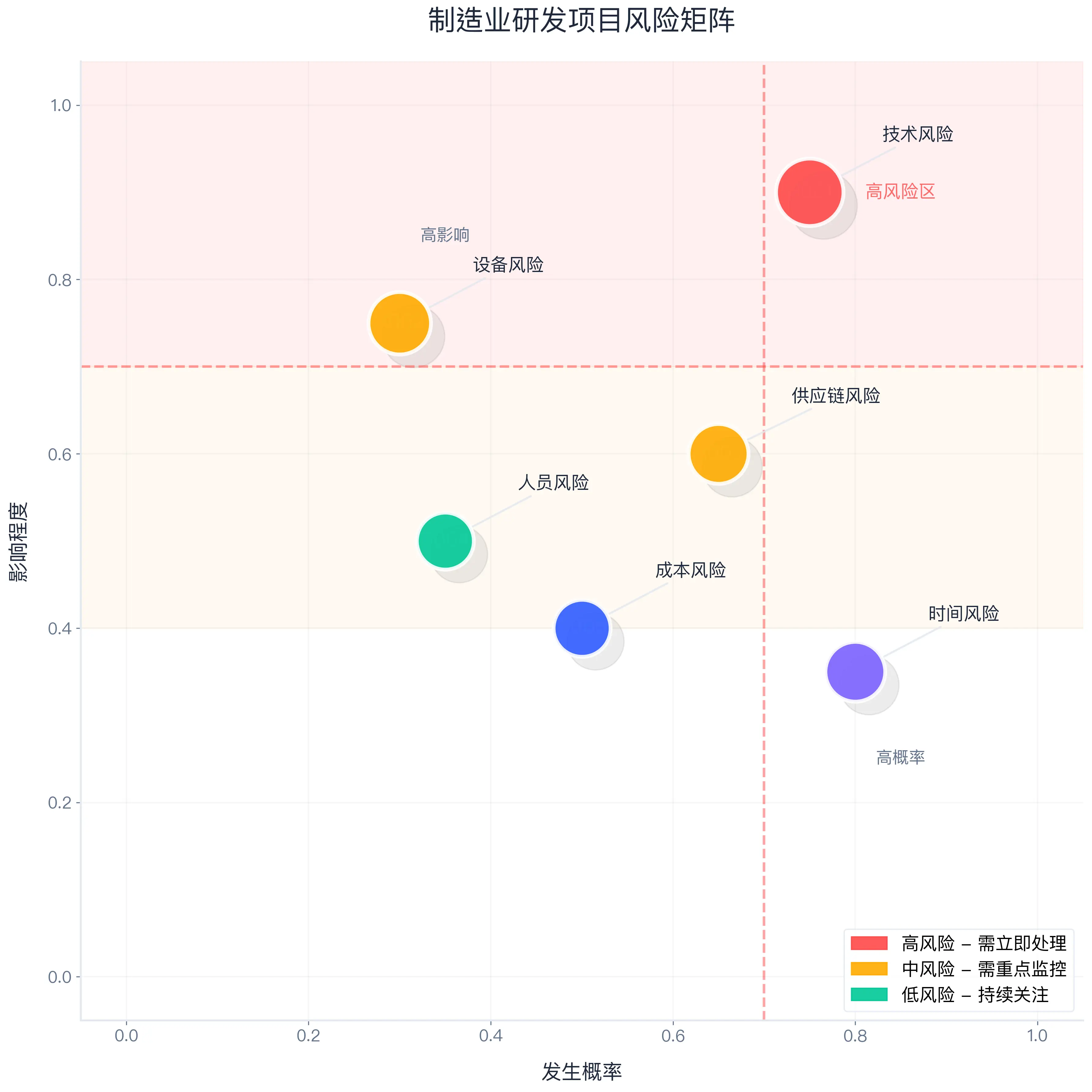
Three problems are common in this kind of program. The technical route may change because experimental results are disappointing or a new technology appears; the response is a technical review committee and a reserved backup route. Resource conflicts may arise from parallel projects or scarce key equipment; the response is a resource pool, priority ranking, and equipment sharing. Team collaboration may break down because communication is poor, responsibilities are unclear, or goals diverge; the response is a clear RACI matrix, regular team building, and a conflict resolution mechanism.
Tools, templates, and the habits that keep plans alive
In 2026, manufacturing R&D teams have several practical tool options: Microsoft Project for traditional project planning, Jira with Confluence for agile R&D management, Smartsheet for flexible table-based planning, Asana for team collaboration and task management, and Monday.com for visual workflow management. Tool selection should consider technical compatibility with CAD, CAE, and CAM systems; data security and access control for intellectual property; the team learning curve; and license and maintenance costs. Implementation should start with one or two pilot projects, include training by role and level, expand only after the pilot works, and continue adjusting based on feedback.
A project plan document should cover the project overview, background, goals, scope, boundaries, and success criteria; the technical roadmap, key indicators, and technical risk assessment; the WBS, Gantt schedule, and key milestones; human resources, equipment and material needs, and budget allocation; risk identification, response strategies, and monitoring; quality targets, test and validation plans, and improvement mechanisms; organization, RACI roles, and communication planning; and appendices for standards and template files.
The RACI matrix is especially useful when materials, process, test, and quality work overlap:
<table> <thead> <tr> <th>Task or activity</th> <th>Project manager</th> <th>Technical lead</th> <th>R&D engineer</th> <th>Test engineer</th> <th>Quality engineer</th> </tr> </thead> <tbody> <tr> <td>Requirements analysis</td> <td>A</td> <td>R</td> <td>I</td> <td>C</td> <td>I</td> </tr> <tr> <td>Technical solution</td> <td>I</td> <td>A</td> <td>R</td> <td>C</td> <td>I</td> </tr> <tr> <td>Experiment design</td> <td>I</td> <td>A</td> <td>R</td> <td>C</td> <td>I</td> </tr> <tr> <td>Data collection</td> <td>I</td> <td>I</td> <td>R</td> <td>A</td> <td>C</td> </tr> <tr> <td>Result analysis</td> <td>I</td> <td>A</td> <td>R</td> <td>C</td> <td>I</td> </tr> <tr> <td>Report writing</td> <td>R</td> <td>A</td> <td>C</td> <td>I</td> <td>I</td> </tr> <tr> <td>Quality review</td> <td>I</td> <td>I</td> <td>C</td> <td>I</td> <td>R</td> </tr> </tbody> </table>R means responsible, A means accountable, C means consulted, and I means informed.
A risk register should be short enough to review and specific enough to act on:
<table> <thead> <tr> <th>Risk ID</th> <th>Risk description</th> <th>Probability</th> <th>Impact</th> <th>Level</th> <th>Response</th> <th>Owner</th> <th>Status</th> </tr> </thead> <tbody> <tr> <td>R001</td> <td>Key technology cannot be breakthrough</td> <td>Medium</td> <td>High</td> <td>High</td> <td>Technical backup route</td> <td>Dr. Zhang</td> <td>Monitoring</td> </tr> <tr> <td>R002</td> <td>Key equipment failure</td> <td>Low</td> <td>High</td> <td>Medium</td> <td>Equipment maintenance plan</td> <td>Engineer Li</td> <td>Mitigated</td> </tr> <tr> <td>R003</td> <td>Raw material supply delay</td> <td>Medium</td> <td>Medium</td> <td>Medium</td> <td>Backup supplier</td> <td>Procurement</td> <td>Monitoring</td> </tr> <tr> <td>R004</td> <td>Team member departure</td> <td>Low</td> <td>Medium</td> <td>Low</td> <td>Knowledge documentation</td> <td>Project manager</td> <td>Prevented</td> </tr> </tbody> </table>Manufacturing R&D plans succeed when technical, resource, schedule, quality, and risk decisions are connected. Cross-functional teams need clear roles and a rhythm for sharing bad news. Plans need to be updated from data and experience, not defended as if they were fixed. Tools help, but they cannot replace technical leadership and team management. In the 2026 manufacturing environment, plans also have to account for digital transformation, sustainability requirements, and supply chain resilience. A credible plan is one that can absorb a failed experiment, a delayed furnace, or a changed customer requirement without losing the logic of the program.