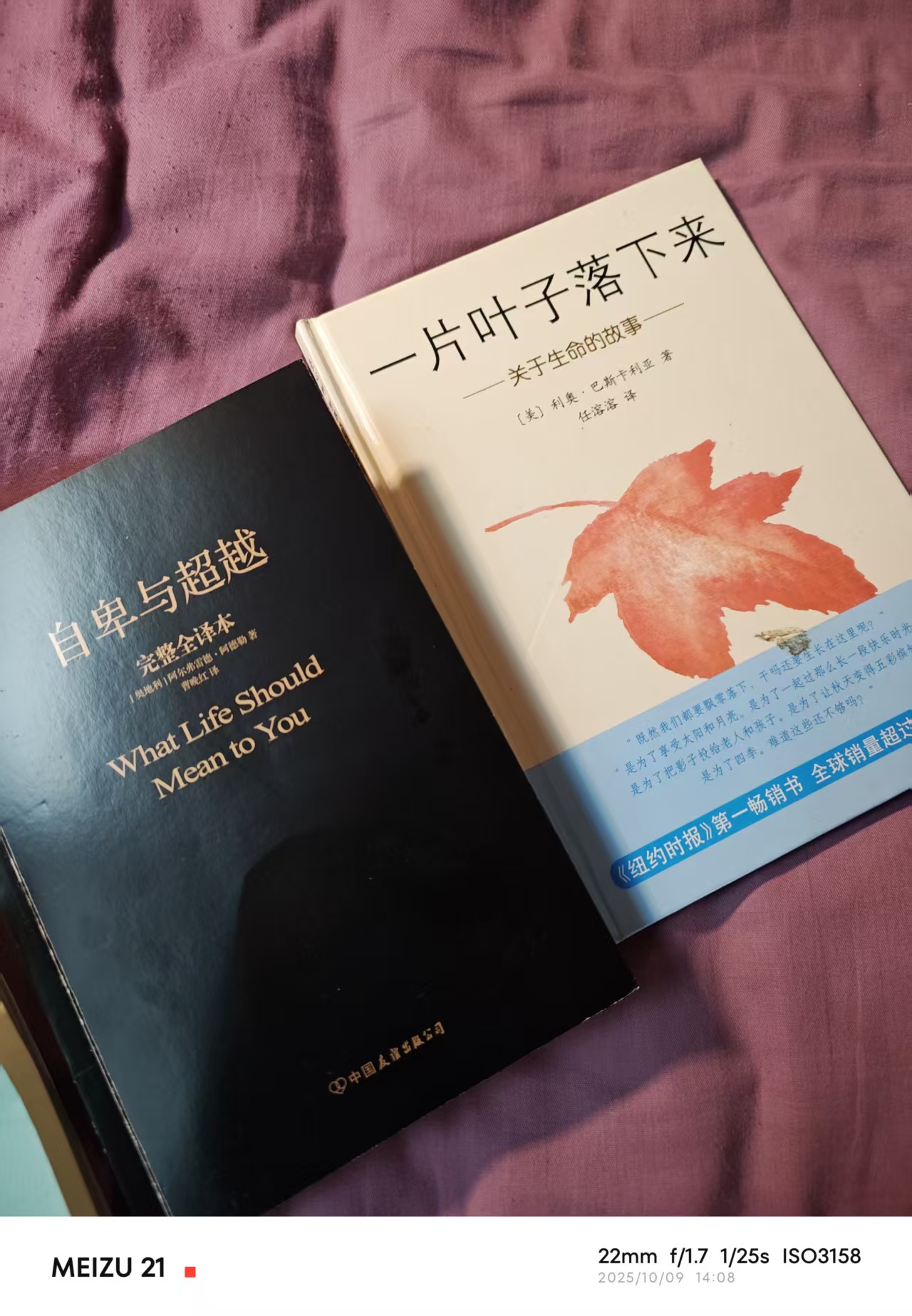
Alfred Adler opens What Life Could Mean to You with a short essay titled 'The Meaning of Life for Us.' Its first two sentences set the frame: human beings live inside meaning. The things we encounter are not bare facts; what matters is what those facts mean to us.
The essay, and the book around it, is famous enough that I will not quote it at length. Serious books on psychology and philosophy often feel abstract; once they are packaged as books, every small point gets expanded and taken apart. That can be responsible to the reader, and it also fills pages. Depth of thought does not have to depend on length. The old Chinese thinkers often put a great deal of philosophy into very few words. Adler's nearly thousand-character opening essay seems to me close in spirit to the opening of Laozi's Dao De Jing: 'The Dao that can be spoken is not the eternal Dao; the name that can be named is not the eternal name.' Both are setting up something metaphysical that does not really need many words. If the outline is explained in too much detail, the core idea can become harder to grasp. Or perhaps that is just my own limitation.
Boiled down, Adler seems to say four things: we are human beings and need to understand the meaning of life; people usually sit down and think about that first point when they hit a low point; the meaning of life shows up in human behavior and feeling; and each person understands that meaning differently.
That gave me something, but it also left a vague unease. The essay still feels a little idealist to me, and point three needs a supplement.
From the standpoint of an individual, I would define the meaning of life as purposeful behavior together with the bodily sensations and emotional states it produces. Both sensation and emotion are present-tense. They happen now, in real time. Individual action and felt experience create meaning as they occur.
Purpose is load-bearing. Behavior without purpose does not generate the meaning of life. In this respect, humans as intelligent creatures are no different from creatures at other levels. The unconscious movements of a person in a psychotic state carry no life meaning. A wolf that kills a sheep to survive, during the act and afterward in the fullness of its belly, is living through meaning.
Liu Cixin's line in The Dark Forest applies here: 'Survival is the first need of civilization.' For humans and other living things alike, survival is one of the meanings of life, and the most basic one. To survive, a creature must act. Once it acts, meaning appears. After behavior appears, humans and animals both have bodily sensations and emotions, and those sensations and emotions also belong to the meaning of life. The biggest difference between humans and lower animals is that humans can understand bodily sensation and emotion as the meaning of life, while lower animals cannot. If animals began to think about the meaning of life, they would have evolved to the level of human civilization. But for an individual animal, its survival behavior and the hunger and pleasure it brings should still count as the meaning of that animal's life.
After Buddhism entered China and was blended over centuries with Chinese civilization, it eventually formed a body of thought suited to the Chinese spirit. There is something practical in it. Zhaozhou's 'Go and have tea,' Nanquan cutting the cat, Yunmen's 'sesame cake,' Dongshan wading through water—in these koans with their sharp exchanges, we can clearly see the Buddhist idea of cherishing the present moment. That is quite close to what individual psychology describes as an individual's awakening to the meaning of life. Ancient Eastern wisdom and Adler's individual psychology arrive at similar places by different roads.
All of this is from the angle of the individual person. In psychology there is a branch called individual psychology, and Alfred Adler was its founder. But on the subject of the meaning of life, his opening essay is not broad enough.
A person faces three things in life: the self, society, and nature. When a person stands before any of these three, meaning arises.
Too much theoretical prose becomes flavorless. Better to say something more felt.
In The Fall of Freddie the Leaf, Freddie, a leaf, asks a question that makes all of us stop and think: 'If we are going to fall and die, why do we grow here at all?' Daniel, an older leaf beside him, gives an answer: 'For the sun and the moon. For the long, happy time together. For the shadows we cast for old people and children. For making autumn colorful. For seeing the seasons. Isn't that enough?'
What Leo Buscaglia puts into the leaves' mouths may be the most complete explanation of the meaning of life. For a person existing alone, the meaning of life is bodily sensation and emotion. But humans are social creatures, so the meaning of life also lies in contribution to the group. Humanity is a large tree, and each person is a leaf. Leaves gathered together make shade that nourishes human civilization.
That leaves one more question. When a person stands before nature, what is the meaning of that person's own life?