Warning
This article was last updated more than 70 days ago, so some details may have changed.
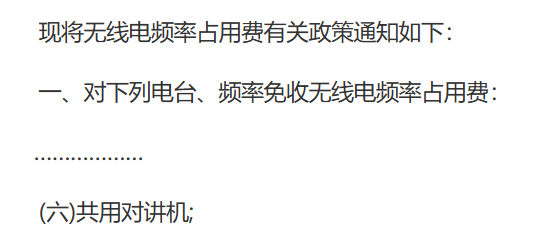
A new policy notice issued by the Ministry of Finance and the National Development and Reform Commission, Caishui ?2026? No. 35, Notice on Policies Related to Radio Frequency Occupancy Fees, brought one genuinely encouraging point: Section 1, Item 6 explicitly states that shared two-way radios are exempt from frequency occupancy fees.
At the moment, when the old situation is fading out and the new one still has not fully arrived, that counts as one of the few pieces of good news.
What a shared two-way radio actually is
People who have been following this topic will know that shared two-way radios are a fairly new category, defined in the MIIT-related notice Guowuban ?2025? No. 1. In simple terms, the framework looks like this:
- Frequency range: 406.2125 MHz to 407.7 MHz
- Channel count: 120 channels, or 240 in narrowband mode
- Mode: digital only
- Power: 5 watts
- License required: yes, though simplified local processing is encouraged
- Operator exam required: no
- Dependent on mobile networks: no
- Mobile/base vehicle radios allowed: yes
This makes shared radios one of the few legal replacements for the widely used but non-compliant handhelds still common on construction sites, in security work, hotels, self-driving travel groups, and similar settings. They also have some clear advantages over the older 409 MHz public radios: higher power and far more channels.
That is why this category looks promising. The problem is that it is still new, and finished products remain limited.
A few known models include:
- Xiaomi digital two-way radio, with the caveat of ecosystem lock-in
- Motorola C360, based on the common DMR standard, priced at 998 RMB
- Deli DLB468D, also based on general DMR, sold for a little over 200 RMB
Many other models can be found in approval databases, but most of them appear to be stuck at the stage of “approved model number obtained,” with no obvious sign of actual market availability.

The fee exemption is not supported by just one document. Another supporting policy, the NDRC notice on optimizing and improving radio frequency occupancy fee standards, also clearly excludes shared two-way radios in its appendix.

So with this clarification, the rumor that spread widely last year ? that shared radios would have to pay occupancy fees ? effectively falls apart. More likely, that confusion came from salespeople not keeping up with the newest rules, or from the fact that the policy had not yet been stated this plainly.
Why this matters
The biggest benefit is straightforward: shared radios become a more realistic legal option.
If no frequency occupancy fee is charged, and the only administrative step is a relatively simple license process, then these radios become highly attractive for places like construction sites, hotels, and school sports events. Compared with 0.5-watt public radios, they offer more power and many more channels. For hotels and school events, public-network radios may still work fine, but shared radios now look more viable than before.
The allowance for vehicle-mounted sets matters too. For people who use radios during road trips and want to install equipment in a car legally, this is also good news. A compliant in-vehicle radio setup is at least possible on paper.
That said, the good news does not erase the difficulties. There are still several practical obstacles in the way.
The real bottlenecks
Digital radios are still too expensive
This has been a long-standing point of frustration.
Shared two-way radios are required to use digital mode only. That likely traces back to the well-known MIIT 2009 document No. 666, which effectively halted approvals for analog two-way radios and pushed the market toward digital migration. Only a small number of service categories were still allowed to produce analog radios, one of them being the heavily abused category of FM handheld stations for amateur service.
That loophole explains why so many analog radios are still sold openly. In regulatory terms, “amateur service” here really does mean amateur radio. Under the rules, that requires an operator certificate obtained by examination, plus a station license, and it cannot be used for commercial activity.
So why does this loophole persist? Because digital radios cost more.
A major reason is the vocoder, one of the core components in a digital radio. In many cases it involves licensing fees because the key patents belong to others. For example, the de facto standard used in DMR systems, the AMBE family, is patented by DVSI. Based on listed pricing, even the cheaper AMBE-4020 series starts at about USD 25 per chip.
There are domestic alternatives. One example mentioned in the market is the WT3080 chip, which relies on software plus a locally implemented solution and is believed to be cheaper, but it still seems to cost several dozen RMB per chip, somewhere around 60 RMB.
Some manufacturers may try to avoid this problem by switching to different vocoders. Xiaomi may be one such case, though that is not certain. The issue is that radios using different vocoder standards cannot communicate with each other. The vocoder is basically the radio's “language.” If one device speaks Chinese and the other speaks English, both may be transmitting, but they still cannot understand one another. That is why ecosystem lock-in is a serious concern with some digital products.
And the vocoder is only one part of the bill of materials. Once you add the MCU, power amplifier, and RF circuitry, it is easy for a digital handheld to end up costing over 100 RMB, and prices above 200 RMB are not unusual. The main exception is the kind of stripped-down low-cost product that forces the issue through sheer cost cutting.
By contrast, the analog radios flooding the market can easily sell for less than 100 RMB, and some pairs are sold for as little as 40 RMB for two units. If someone with little knowledge of radio law is simply told to choose a walkie-talkie, it is hard to imagine many people deliberately picking the more expensive option.
Too many people still do not know licensing is required
Another major reason illegal radios are so widespread is simple: many people ? including sellers and livestream promoters ? still do not realize that two-way radios can require licensing at all. They assume every radio can be bought and used immediately.
Shared radios do provide a licensing path that is meant to be simpler. But if people have never even developed the awareness that licensing exists, then simplifying the paperwork only solves part of the problem. Many will just misread it as some strange new rule and continue using non-compliant equipment.
Public communication around this remains weak. Marketing language from manufacturers is often vague as well. If the cost issue described above were reduced, and if authorities also required manufacturers to label products more clearly ? for example, “This is an amateur-service radio and requires certification to use,” versus “This is a shared two-way radio and only needs a simplified station license” ? the situation might improve.
There is also another possibility. If shared radios become common enough, online searches for “walkie-talkie” may eventually return mostly shared-radio products. In that case there would still be unlicensed users, but at least they would be operating inside a band specifically allocated for this type of equipment, rather than interfering with other radio services.
Existing users would have to replace everything
Imagine being the owner of a construction company or a hotel with dozens of radios already in service. If you are told to replace all of them with shared radios, would you do it?
Because shared radios are digital and traditional handhelds in many of these environments are analog, the two systems cannot communicate. That means you cannot really test the transition gradually by replacing only a few units first. Once you switch, you have to switch the entire fleet.
So even if the cost of each unit were not a problem, a full replacement still requires money, time, and organizational effort. The gains are not always obvious from the user's point of view. In plain practical terms, many people simply do not want the trouble. Without some form of pressure ? whether from regulators or from a corporate headquarters ordering compliance across a group ? people on the ground are unlikely to move first.
That kind of pressure is not purely hypothetical. There have already been reports from radio retailers that more construction buyers are now purchasing public-network radios, and hotels are doing the same. The most likely explanation is not difficult to guess: somebody probably got inspected.
Shipment volumes are still low
The standard itself is new, and there is still some incompatibility in the market. Under those conditions, manufacturers are naturally cautious.
If you were running a radio factory, you probably would be too. Development, production, logistics, and warehousing all cost money. They take time and tie up capacity. Many radio makers on the mainland do not build everything from the ground up anyway; a large share rely on turnkey designs or contract manufacturing and then apply their own branding. If a batch of shared radios is produced and then sells poorly, that inventory turns into a direct loss.
Meanwhile, analog radios ? however non-compliant they may be in many cases ? remain cheap, mature, and broadly interoperable with what users already have. From a manufacturer's perspective, that is a proven path, so confidence is naturally higher.
In other words, the regulations point to a potentially promising market, but for now the outlook still feels uncertain. Quite a few models have already passed approval, as the database listings show, yet large-scale shipment does not seem to have happened. And despite the rules clearly allowing it, the much-anticipated vehicle-mounted shared two-way radio still has not really arrived.
A good policy, but still a waiting game
Shared two-way radios are a genuinely useful idea. The explicit fee exemption helps, and it removes one of the biggest doubts surrounding the category.
But at this stage, waiting is still the main reality. Waiting for lower prices, waiting for clearer labeling, waiting for broader awareness, waiting for manufacturers to ship at scale, and waiting for the product ecosystem ? especially vehicle-mounted sets ? to catch up.
For now, that is where things stand.