“We know developers have adopted vibe coding extremely quickly. Dario Amodei once said that 70% to 90% of Anthropic’s code was written by Claude. That means human attention toward open-source software producers is shrinking.”
— Miklós Koren, co-author of Vibe Coding Kills Open Source
In January 2026, a paper from researchers at Central European University and Kiel University dropped into the developer world with all the subtlety of an alarm bell. Its title said exactly what many people were not ready to hear: Vibe Coding Kills Open Source.
This was not a blog-post provocation. It was an economic argument, modeled and formalized by researchers. And less than two weeks later, reality supplied an unnervingly clean case study: Tailwind CSS cut 75% of its engineering team after revenue fell by nearly 80%.
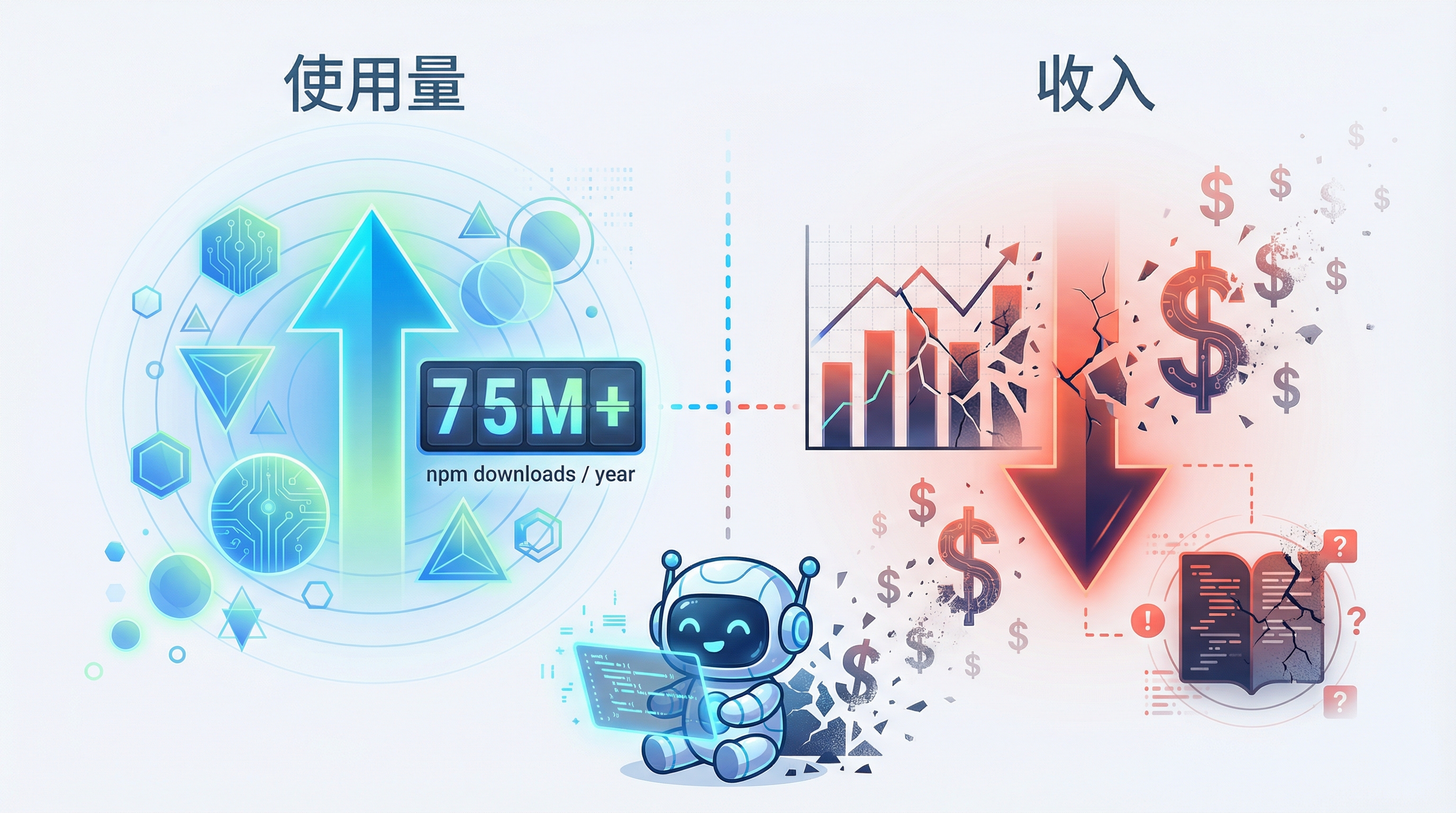
The ugly twist is that Tailwind usage was at an all-time high.
Vibe coding stopped being a joke
The phrase vibe coding started as a throwaway term coined by OpenAI co-founder Andrej Karpathy in February 2025. The idea was simple enough: describe what you want in natural language, let an AI produce the code, skim the result rather than fully understand it, run it, and if it fails, tweak the prompt and repeat.
A year later, the term had been named Collins Dictionary’s word of the year for 2025, and the numbers behind it were even more striking than the definition:
- 92% of U.S. developers use AI coding tools daily
- 82% of developers worldwide use them at least weekly
- 41% of global code is AI-generated
- By 2024, AI had already generated 256 billion lines of code
- 87% of Fortune 500 companies had adopted at least one vibe-coding platform
- 74% of developers reported productivity gains
Gartner’s estimate is even more sweeping: by the end of 2026, 90% of new applications will rely on AI coding tools.
At this point, calling it a trend undersells it. It is already the default.
Even Linus Torvalds is doing it
If adoption statistics still feel abstract, consider who has started using these tools.
In January 2026, Linus Torvalds wrote in the README for his new open-source project AudioNoise:
“the python visualizer tool has been basically written by vibe-coding”
This matters because Torvalds is not exactly known for tolerance toward sloppy code. The core DSP code in C was still written by hand, while the AI-assisted part was a Python visualization tool created with Google Antigravity, an AI IDE built on Windsurf. He had also made his position clear before: vibe coding is acceptable, but not for “important stuff.”
That restraint is part of why the signal is so strong. When one of the most skeptical and exacting programmers in the world begins using AI for some parts of development, it becomes difficult to argue that the wave is reversible.
The real question is no longer whether developers will use AI coding tools.
The question is: what do they erode while making us faster?
The paper’s central argument
The researchers — Miklós Koren, Gábor Békés, Julian Hinz, and Aaron Lohmann — frame vibe coding as a force with two opposing effects.
1. Higher productivity
This is the obvious part. AI lowers the cost of using and assembling open-source software. Instead of reading documentation, learning APIs, troubleshooting integrations, and stitching pieces together manually, a developer can now type something like, “build me a responsive navigation bar with Tailwind,” and get something usable almost instantly.
That is real productivity.
2. Weaker incentives for maintainers
The second effect is more subtle and more dangerous.
Open source often monetizes itself indirectly through human participation. Users read docs, browse examples, file issues, join discussions, discover paid products, sponsor maintainers, and build enough familiarity with a tool to support its ecosystem.
When AI becomes the interface between developers and software, much of that human contact disappears. The user still benefits from the project, but the maintainer loses the visits, the attention, the relationship, and often the revenue path.
The paper’s conclusion is bleak:
If open source primarily monetizes through direct user engagement, then widespread adoption of vibe coding will reduce entry and sharing of new projects, lower diversity and average quality, and may reduce overall welfare even as coding becomes faster.
In plain English: individual developers may get more efficient while the ecosystem they depend on gets weaker.
Tailwind is the textbook example
Only two weeks after the paper appeared, Tailwind provided a nearly perfect real-world illustration.
On January 6, 2026, Tailwind Labs founder Adam Wathan wrote in a widely shared GitHub comment:
“Tailwind is growing faster than ever before and is bigger than it’s ever been. But our revenue is down almost 80%.”
The contrast in Tailwind’s numbers was almost absurd:
<table> <thead> <tr> <th>Metric</th> <th>Direction</th> <th>Data</th> </tr> </thead> <tbody> <tr> <td>Monthly npm downloads</td> <td>Up</td> <td>75M+ (all-time high)</td> </tr> <tr> <td>Websites using it</td> <td>Up</td> <td>617,000+</td> </tr> <tr> <td>Documentation traffic</td> <td>Down</td> <td>40% lower since 2023</td> </tr> <tr> <td>Revenue</td> <td>Down</td> <td>Nearly 80%</td> </tr> <tr> <td>Engineering team</td> <td>Down</td> <td>75% cut (from 4 to 1)</td> </tr> </tbody> </table>Tailwind’s business model was straightforward. The framework itself was free. The company monetized through paid products like Tailwind Plus, with its documentation site serving as the funnel.
The flow looked like this: developers visit docs → discover paid products → buy them.
That path breaks when developers ask Claude Code, “How do I add responsive padding with Tailwind?” and get the answer immediately. The code gets written, the problem gets solved, and the developer never visits tailwindcss.com at all.
The deeper irony is hard to miss: some of the biggest AI tools generating Tailwind code — Claude, Cursor, Grok — also use Tailwind heavily in their own interfaces. They consume the ecosystem’s knowledge while making its usual discovery and monetization channels less relevant.
The llms.txt dilemma
In November 2025, a developer opened PR #2388 on the Tailwind docs repository proposing a /llms.txt endpoint: a single AI-friendly text file combining all 185 documentation files.
The day after the layoffs, Wathan closed the PR and replied:
“Making it easier for LLMs to read our documentation would just mean less traffic to our docs, which means fewer people learning about our paid products, which means the business is less sustainable.”
That is the bind in one sentence.
Make your docs easier for AI to consume, and you may accelerate the collapse of your revenue model. Refuse to optimize for AI, and you risk becoming less visible in the environment where developers increasingly work.
Saved by the same forces causing the problem
Within 48 hours of the news, major tech companies stepped in with sponsorships. Vercel and Google’s AI team were among those backing Tailwind.
But the irony did not go away. If anything, it sharpened.
The companies helping keep Tailwind alive were also among those building products that generate Tailwind code at scale: v0, Cursor, Lovable, and others. They were, in effect, funding the knowledge base their own products were simultaneously draining.
Stack Overflow tells the same story from another angle
Tailwind is not an isolated case. Stack Overflow reflects the same pattern in a different form.
- Monthly questions fell from a peak of 200,000+ in 2014 to just 3,862 in December 2025 — a 78% collapse
- Traffic fell back to roughly 2008 levels, erasing about 15 years of growth
- The company was sold in 2021 for $1.8 billion, which in hindsight looks like impeccable timing
After ChatGPT launched in November 2022, the decline in question volume turned cliff-like. But AI was not the only reason. Stack Overflow had already built a reputation for harsh moderation and quick closures, especially toward beginners. That pushed users away long before AI offered them an alternative.
What AI did was accelerate the shift.
People still need answers. They just get those answers through AI now. Usage remains, but the traffic no longer shows up where the old business and community models expected it.
That has implications far beyond one Q&A site. Any open-source project or technical community built on a “traffic leads to conversion” model is exposed to the same risk.
Faster output, worse code
The economic pressure is only one side of the story. The other is quality.
In December 2025, CodeRabbit published State of AI vs Human Code Generation, analyzing 470 real open-source GitHub pull requests. The headline finding was stark:
AI-generated code contained an average of 10.83 issues per PR, compared with 6.45 for human-written code — about 1.7 times as many.
Broken down by category, AI code performed worse across much of the board:
<table> <thead> <tr> <th>Issue type</th> <th>AI vs Human</th> <th>Multiple</th> </tr> </thead> <tbody> <tr> <td>Logic errors</td> <td>AI higher</td> <td>1.75x</td> </tr> <tr> <td>Code quality / maintainability</td> <td>AI higher</td> <td>1.64x</td> </tr> <tr> <td>Security vulnerabilities (overall)</td> <td>AI higher</td> <td>1.57x</td> </tr> <tr> <td>XSS vulnerabilities</td> <td>AI higher</td> <td>2.74x</td> </tr> <tr> <td>Algorithm / business logic errors</td> <td>AI higher</td> <td>2.25x</td> </tr> <tr> <td>Concurrency control errors</td> <td>AI higher</td> <td>2.29x</td> </tr> <tr> <td>Performance issues (such as excessive I/O)</td> <td>AI higher</td> <td>~8x</td> </tr> <tr> <td>Readability problems</td> <td>AI higher</td> <td>3x+</td> </tr> </tbody> </table>There were a few categories where AI did better. It made fewer spelling mistakes, and its output was generally more testable.
Still, one survey result cuts through the productivity narrative: 63% of developers said they had at least once spent more time debugging AI-generated code than it would have taken to write the code themselves from scratch.
That is the productivity illusion.
AI can make code appear quickly. But if the downstream cost includes debugging, refactoring, security review, and cleanup, the net gain may be far smaller than the initial speed suggests.
Developers use AI constantly — and trust it less and less
The 2025 Stack Overflow developer survey surfaced another contradiction:
- 84% of developers use AI coding tools
- Only 29% trust their accuracy, down from 40%
- 46% explicitly say they do not trust AI
- Yet 62% still use it every day
So the day-to-day reality of software work in 2026 looks something like this: developers rely heavily on tools they do not fully trust to generate code they do not fully feel safe shipping.
A 2024 CHI conference study pushed the concern further, finding that 52% of ChatGPT answers to Stack Overflow questions were incorrect.
That gap between usage and trust matters. It suggests that AI coding tools are becoming infrastructural before they have become reliably dependable.
What a sustainable response might look like
The researchers behind Vibe Coding Kills Open Source do not frame their work as apocalypse. They describe it as a call to act before the damage hardens into the new normal.
Several directions stand out.
A Spotify-like payout model for open source
The paper’s most direct proposal is that AI platforms should redistribute part of their subscription revenue to maintainers based on package usage.
The comparison to Spotify is deliberate. Musicians get paid, however imperfectly, when their work is streamed. By the same logic, if Claude Code, Cursor, or Copilot derives value from the knowledge embedded in an open-source library, some of that value should flow back to the people maintaining it.
This is not charity. It is a sustainability mechanism.
If a project like Tailwind loses the ability to fund maintenance, the ecosystem degrades. Eventually the AI tools depending on that ecosystem also degrade, because the code they are trained on and the documentation they rely on stop improving.
It is a classic tragedy of the commons.
Treat open source as infrastructure
Foundation grants, corporate sponsorships, and public funding may need to shift from optional goodwill to something closer to baseline infrastructure support.
The EU’s Cyber Resilience Act, which has already begun pushing for security audits of critical open-source components, points in that direction. It does not solve the monetization problem by itself, but it reflects a growing recognition that open source underpins too much of modern computing to be left on volunteer fumes.
What individual developers can still do
The problem is structural, but personal habits still matter.
- Give back to the projects you rely on. File issues, improve docs, answer questions, or even just star the repository. Human attention is not trivial; it is part of what keeps open source alive.
- Review AI output seriously. Do not treat generated code as trustworthy by default, especially where security is involved.
- Pay for open-source products when you can. If a project offers a paid companion product, buying it is often an investment in the tools your own work depends on.
- Keep understanding the code. Vibe coding is not a license to stop thinking. The better you understand the underlying system, the better you can direct, evaluate, and correct the AI.

The cost hidden inside convenience
Karpathy probably did not expect a casual phrase to end up as the title of an economics paper. But the phrase stuck because it named something real: a style of programming built on delegation, iteration, and abstraction from the code itself.
The adoption numbers say this mode of work is not going away. If 92% of developers are already using AI coding tools, and 41% of code is now AI-generated, then this is not a future scenario. It is the current operating environment.
But Tailwind’s near-80% revenue collapse and Stack Overflow’s 78% decline in question volume point to a cost that is easy to miss when you focus only on speed.
Every technological leap comes with second-order effects. In this case, the danger is that we optimize for output while starving the ecosystem that makes good output possible.
AI can generate more code than ever. That does not mean it can generate the social fabric that produced the libraries, documentation, examples, discussions, and maintainer labor it feeds on.
That is the real sense in which vibe coding can kill open source.
Not because AI is too powerful, but because open source was never just a pile of code. It was always a network of human attention, reciprocity, and trust.