Some time ago, I came across a report arguing that people in China do not read much. It cited a national reading survey showing that in 2011, the average Chinese person read only 4.35 books a year. The figure had been 4.25 in 2010, 3.88 in 2009, and 4.75 in 2008. Alongside that were comparison figures from other countries: 11 books per person in South Korea, 20 in France, 40 in Japan, 55 in Russia, and 64 among Jews. Put side by side, the contrast made China’s enthusiasm for reading look strikingly restrained.
When people discuss this issue, one common explanation is that books are too expensive. I do not find that convincing at all.
Even if we assume that a book costs 50 yuan on average, that is already on the high side. With an average monthly salary of 3,000 yuan, one month’s income could buy 60 books. Some foreign surveys suggest that a person should spend 15% of annual income on learning. If we apply that standard here, the yearly learning budget would be 5,400 yuan. Even if only one-tenth of that went to books, it would still be enough to buy 9 books a year.
And in modern society, reading is no longer limited to printed books. E-books are cheaper. On many domestic online reading platforms, a book can cost as little as 1 yuan, which means 10 books would cost only 10 yuan. On top of that, given the weak copyright awareness that still exists, free online books and downloadable copies are everywhere. Anyone who truly wants to read can often do so without spending a single cent.
So when the annual average is only 4.35 books, the basic problem is clearly not that books are unaffordable. It is that many people simply do not want to read.
Why is that? A large part of the answer lies in the intensely utilitarian nature of contemporary society. Reading no longer appears necessary, because no matter how much one reads, it usually does not produce immediate economic returns. At least in the short term, books rarely turn directly into money.
Imagine there were a book that could be finished in one day and, once read, would immediately help you earn 1,000 yuan. How many people would rush to read it? Probably anyone making less than 1,000 yuan a day would be interested. But change the scenario: suppose you could finish a book in one day and, after reading it, your level of awareness, understanding, or personal insight would instantly rise. How many people would still care? Many would probably ask a different question first: how much is that worth?
Reading does not bring obvious financial gain, and it does not bring social status either. In earlier times, the educated enjoyed a distinct kind of respect. Institutionally, degree holders such as xiucai and above could receive tax exemptions, state stipends, and special treatment before officials. If they broke the law, their academic rank had to be stripped before imprisonment, and they could not simply be subjected to punishment like ordinary people. Among common people as well, scholars were treated with deference. On the road, they were given precedence; regardless of age, others would address them respectfully as “sir.”
Modern society offers nothing comparable. No matter how learned you are, the state grants no special honor for knowledge itself—unless you hold an elite title, and even then the respect often goes to the status, not to learning. Nor does the wider public necessarily admire knowledge. The first question many people ask is much simpler: how much do you make each month?
If reading brings neither economic benefit nor social standing, it is not surprising that the old claim that “reading is useless” continues to circulate. And once that idea takes hold, fewer people will read.
It is also worth asking what kinds of books people are actually choosing, because that says something about what they want from reading. There may be no comprehensive survey here, but popular online reading lists offer at least a rough indication. The following screenshots were taken from major Chinese book and reading websites on March 6, 2013, showing their heavily clicked or prominently recommended titles:
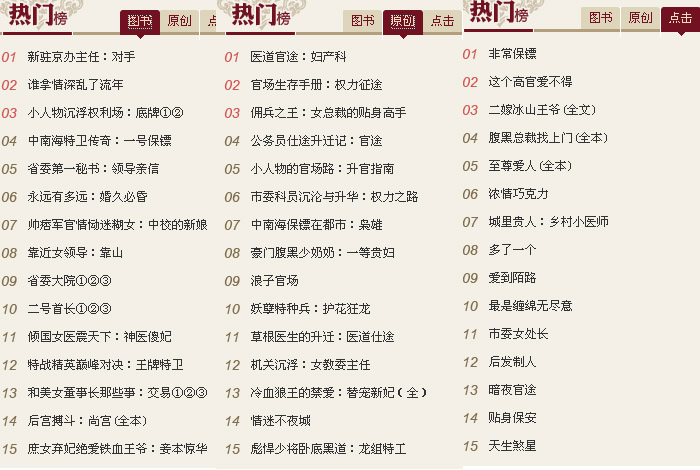
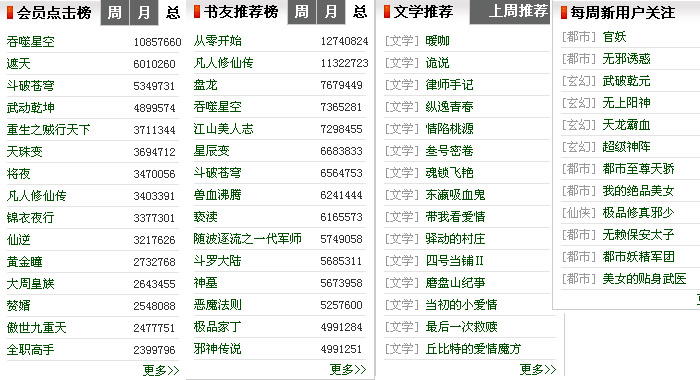
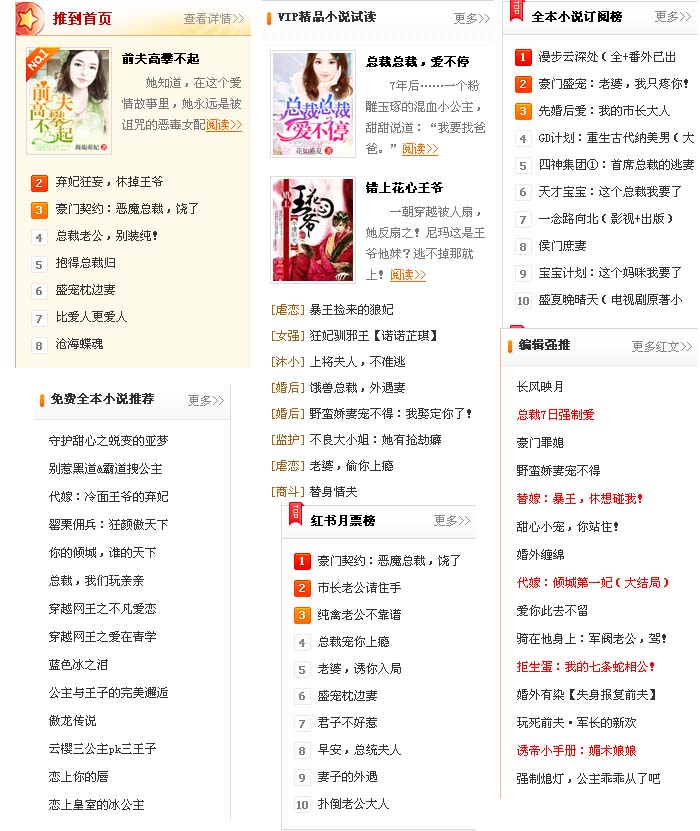
Among the most popular categories, fantasy and erotic content stand out. A taste for fantasy can at least be read as a sign of spiritual emptiness, a need to place one’s hopes in unreal worlds. A taste for erotic material suggests that material desire has overtaken spiritual need altogether. Taken together, these preferences point to a deep vacancy in the inner lives of many people today—and to a tendency to fill that emptiness with sexual stimulation.
That may also help explain why bizarre social phenomena seem so common now, and why pornography continues to spread so easily.