The road to 1900 began well before the guns opened at Dagu. China's defeat in the First Sino-Japanese War in 1895 and the Treaty of Shimonoseki sharply reduced its international standing. Western powers, already competing for concessions, moved toward carving out spheres of influence. The indemnity imposed after the war deepened hardship, helped fuel the Boxer movement, and left the Qing government facing foreign pressure and domestic unrest at the same time. The powers' aims were not limited to punishing disorder; they wanted wider access to the China market and greater control over the country.
Inside the court, the failure of the 1898 reform movement hardened divisions. Guangxu had turned to Kang Youwei, Liang Qichao, and others to push reform, but the movement collided with the conservative faction and failed. Cixi suppressed the reformers and put Guangxu under confinement at Yingtai in Zhongnanhai. Foreign governments sympathized with the reformers, helped Kang and Liang escape, and opposed Cixi's plan to depose Guangxu. That opposition made her resentful. The powers' rush to lease harbors and divide China into spheres of influence added to her xenophobia. Qing corruption, military weakness, and fiscal exhaustion also fed foreign ambitions.
The Boxers, originally called Yihequan and labeled by opponents as Boxer bandits, began as martial arts groups in Shandong. Governor Yuxian used them against Christians and to intimidate converts. Under foreign pressure, Yuan Shikai was sent to Shandong to suppress them, and many Boxers moved toward Zhuozhou outside Beijing. Cixi, trusting conservative officials, listened to Yuxian's claim that the Boxers were invulnerable to blades and bullets. Grand Councilor Gangyi inspected Zhuozhou and reported that heaven had sent the Boxers to destroy foreigners. With the slogan 'Support the Qing, destroy the foreigners,' the Boxers entered Beijing, burned churches, cut telegraph lines, tore up railways, and attacked the Tianjin concessions. Foreign ministers demanded that the Qing court suppress them, but no effective response came. That set the stage for foreign troops to march on Beijing.
In late May 1900 the Legation Quarter in Beijing came under attack. On June 20 Qing troops and Boxers surrounded the legations of Austria-Hungary, Belgium, Britain, France, Italy, Germany, Japan, the Netherlands, Russia, Spain, and the United States, along with the North Cathedral, trapping staff, Catholics, and soldiers inside. Clemens von Ketteler, the German minister, went to the Zongli Yamen to demand protection and was killed on the way. On June 21 Cixi issued an edict declaring war on eleven states: Britain, the United States, France, Germany, Italy, Japan, Russia, Spain, Belgium, the Netherlands, and Austria-Hungary. The court offered bounties for foreigners: fifty taels for a foreign man, forty for a foreign woman, and thirty for a foreign child.
On June 26 Vice-Admiral Edward Seymour took more than 2,000 sailors and marines from Tianjin to try to relieve the legations. At Langfang the force was blocked by Qing troops under Nie Shicheng and by Boxer fighters. The Qing and Boxer side won the Langfang ambush. In July a larger coalition took shape: Britain, the United States, France, Germany, Russia, Japan, Austria-Hungary, and Italy. This was the Eight-Nation Alliance. Its force was estimated at more than 20,000: about 8,000 Japanese, 4,000 Russian, 3,000 British, 2,000 American, 2,000 German troops then in Shanghai, 800 French, 58 Austrian, and 53 Italian.
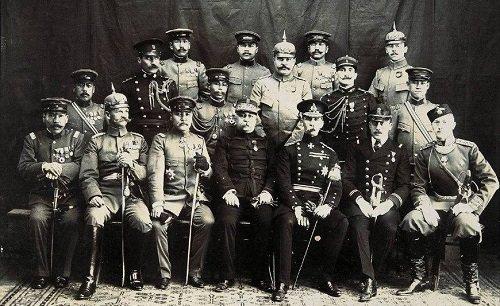
On July 16 the allies attacked Dagu. The Qing commander Luo Rongguang was killed and the forts fell. The coalition then advanced on Tianjin in two columns. Some 20,000 Qing troops and Boxer fighters resisted, but the city fell in a day and a half.
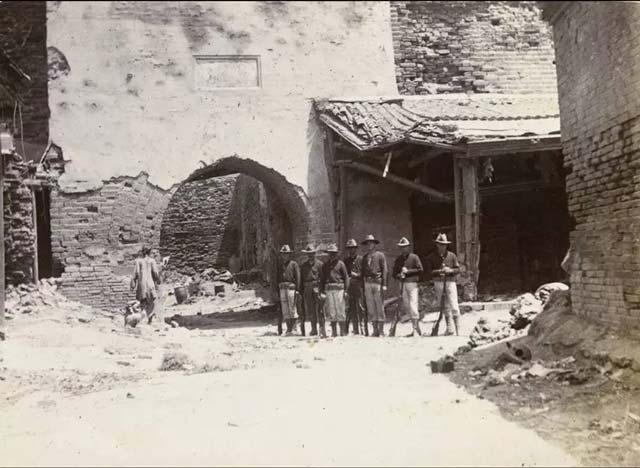
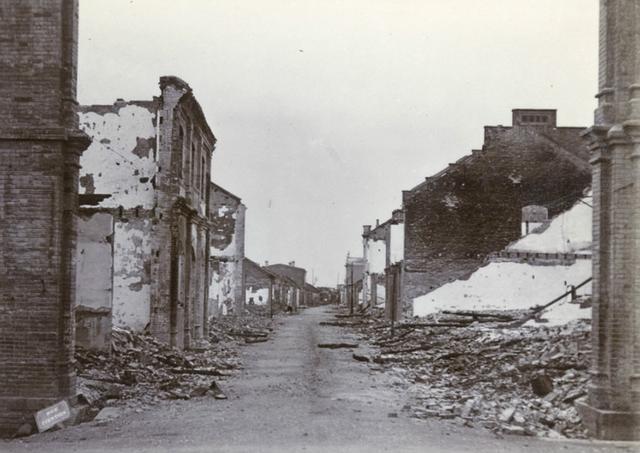
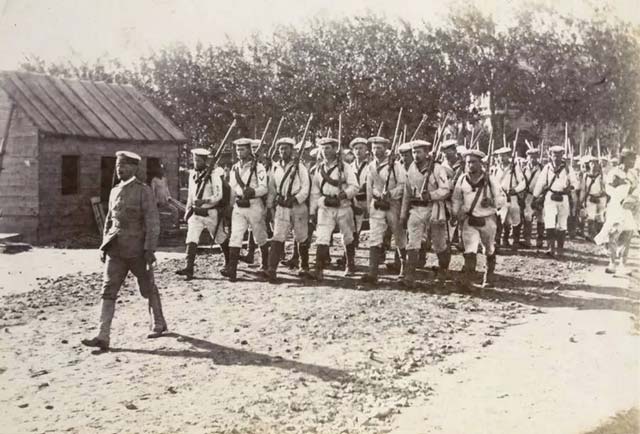
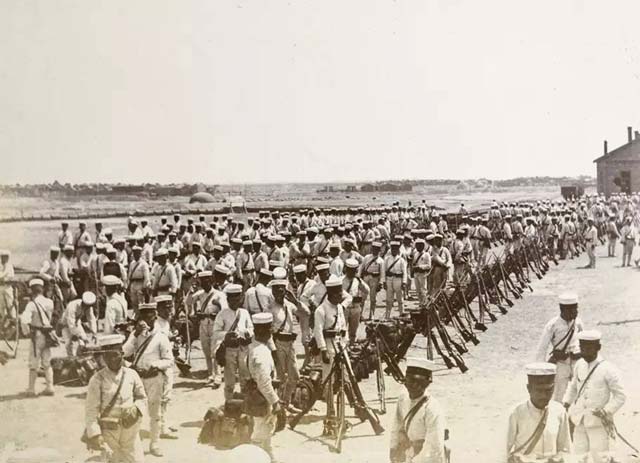
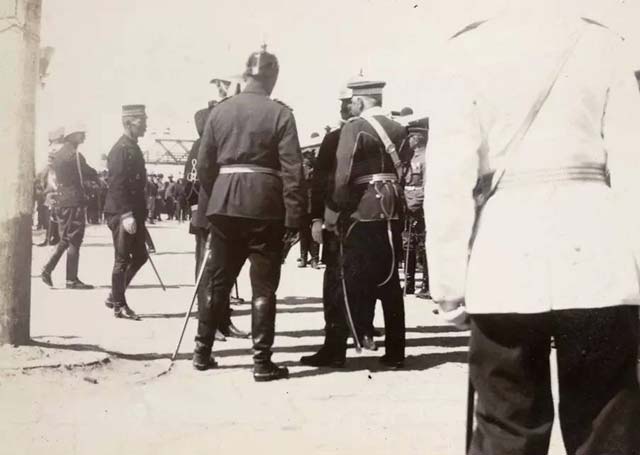
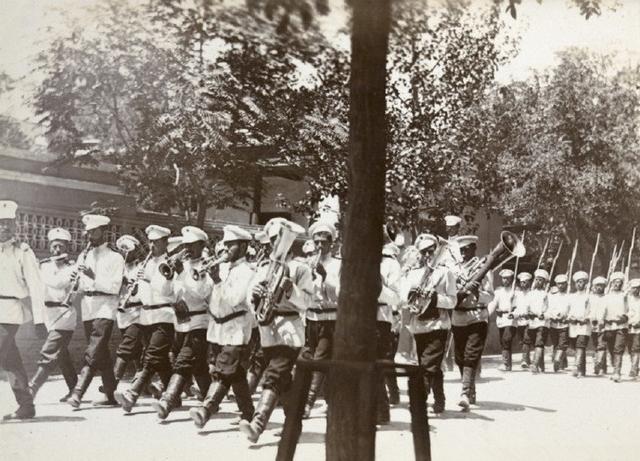
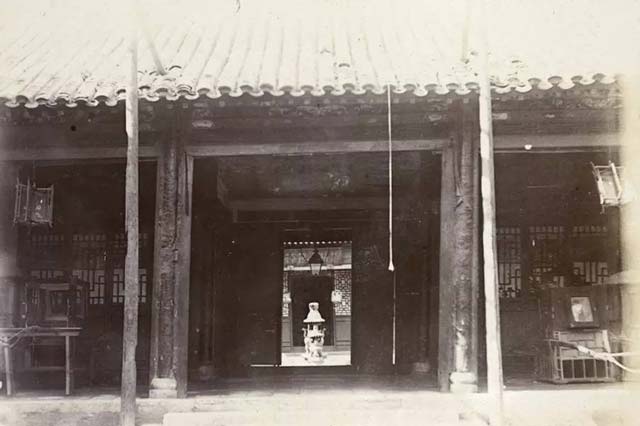
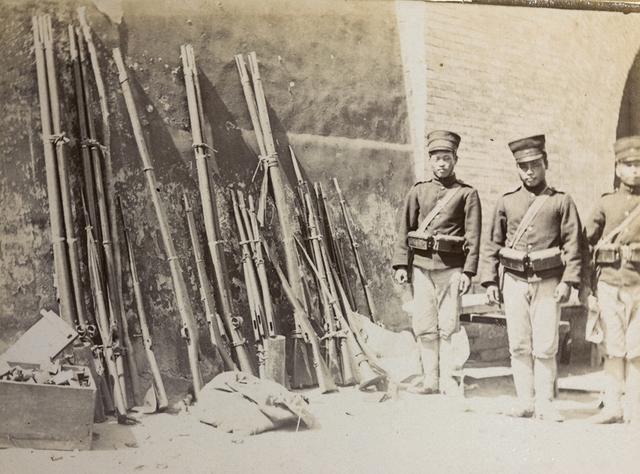
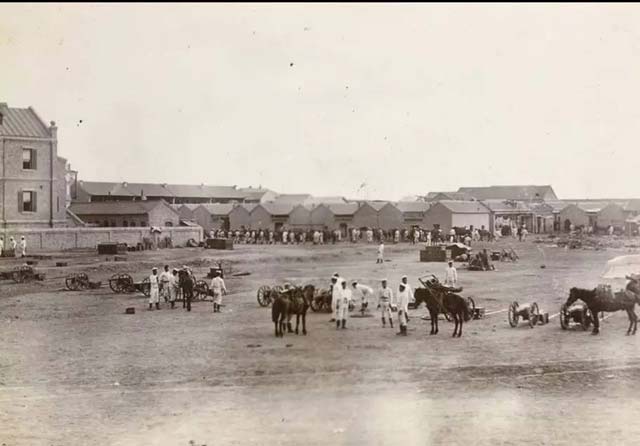
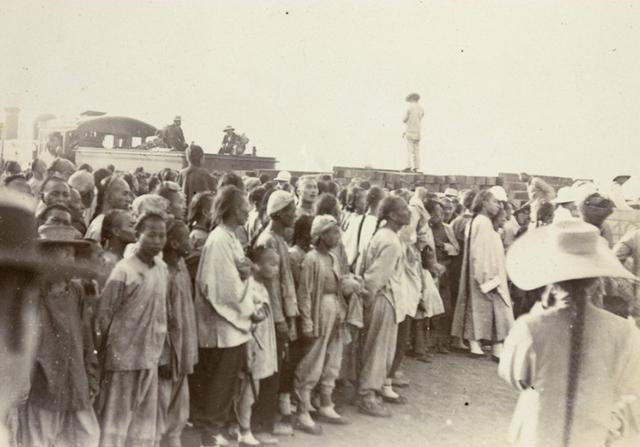
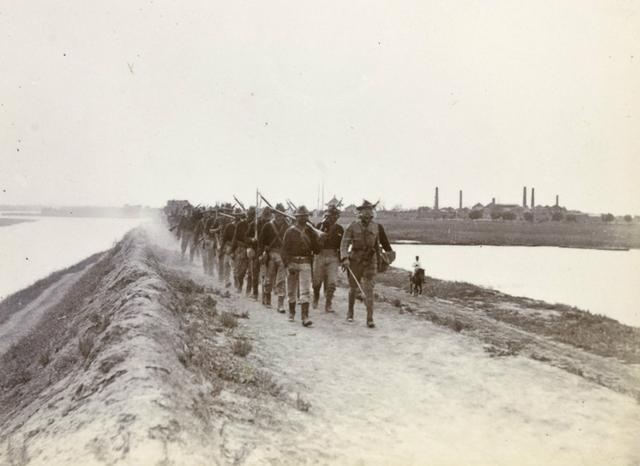
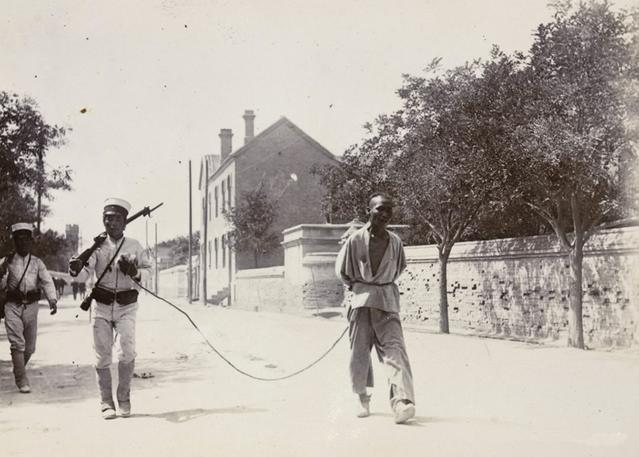
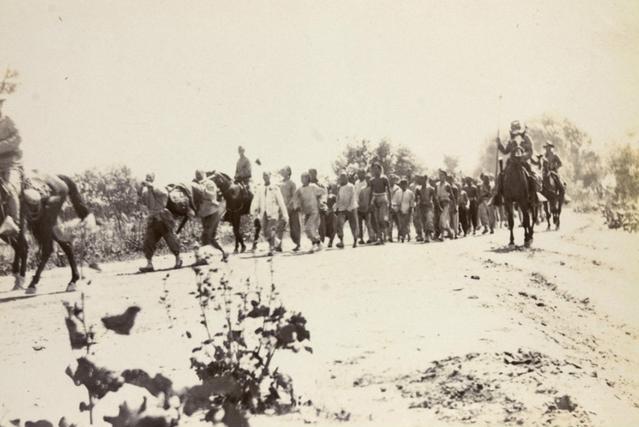
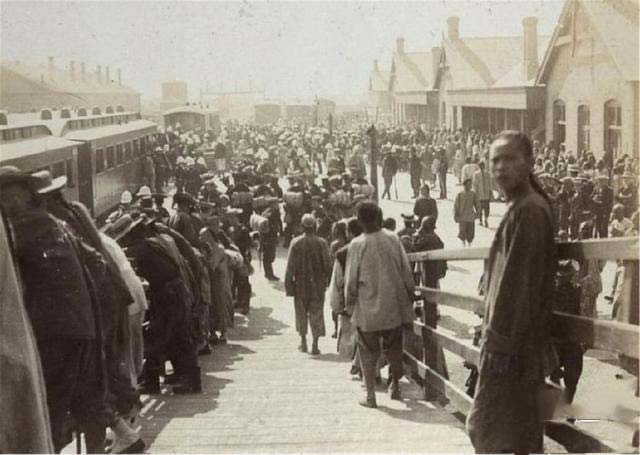
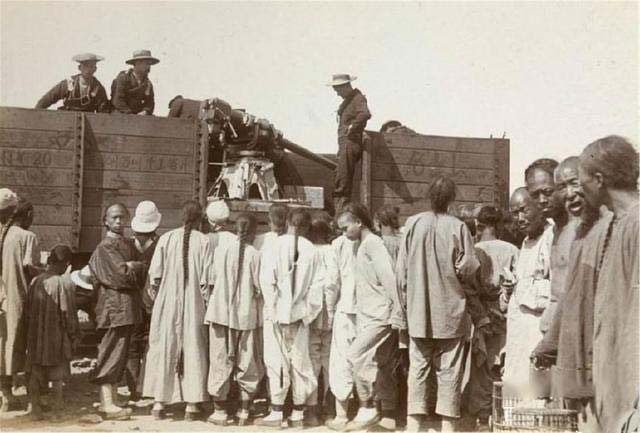
After occupying Tianjin, the allies searched and looted the city, then prepared to move on Beijing. Supplies and troops moved by train and boat, and some Tianjin residents helped load munitions.
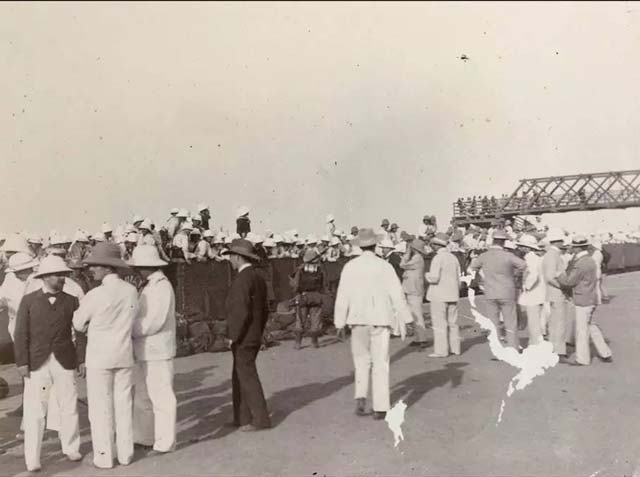
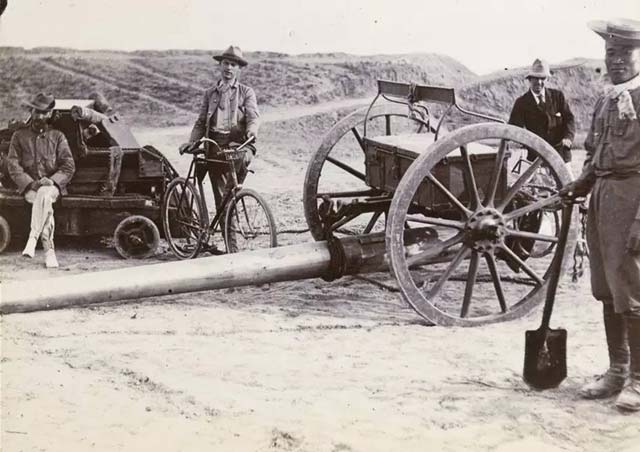
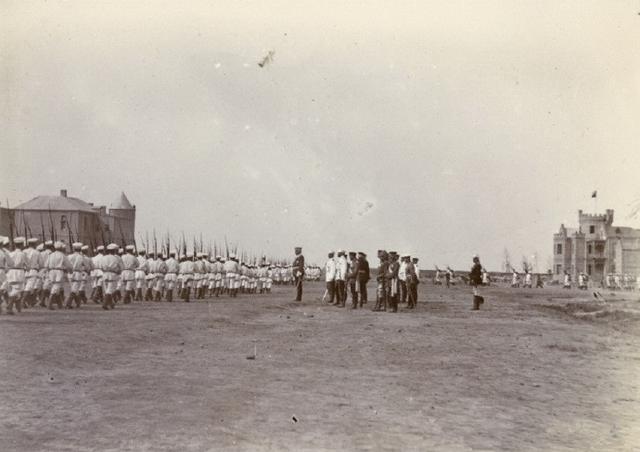
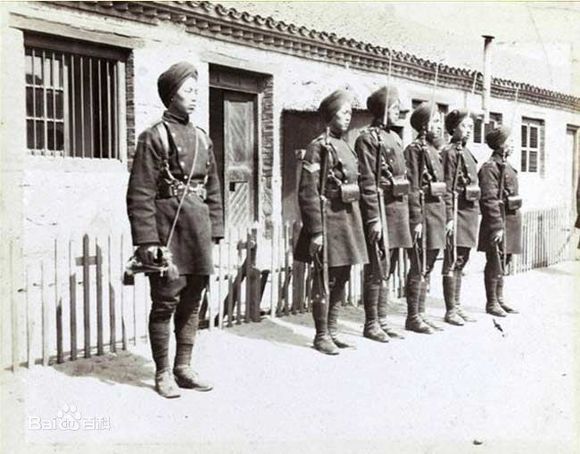
One unit in the campaign deserves separate notice: the Weihaiwei Chinese Regiment, raised by Britain. In November 1898, after recruiting interpreters, buglers, and specialist noncommissioned officers in Hong Kong, the British War Office formally organized the regiment at Weihaiwei. British officers praised the men as tough, patient, and intelligent, good marchers and bearers who could eat little and travel far. They signed three-year terms and could be sent anywhere in the world. Training ran four to five hours a day, and their 600-yard shooting was especially strong. The Times wrote in 1901 that whatever the future held, the regiment would have a reputation for brave and fearless fighting. That reputation was earned in combat against Qing forces. The Chinese term hanjian is difficult to trace, but one reading ties its modern use to Chinese soldiers serving a foreign army in this period.
On August 4 the allies left Tianjin for Beijing. Beijing supposedly had 150,000 Qing troops and more than 300,000 Boxers who believed themselves invulnerable. The transport columns included handcarts and boats on the Chaobai River. On August 5 the Japanese defeated Dong Fuxiang and Ronglu at Beicang. On August 6 the allies defeated Ma Yukun and Song Qing at Yangcun. Dong, Ronglu, and Song commanded the Wuwei rear, center, and left armies. Nie Shicheng of the front army had already died at Tianjin. Four of the five Wuwei armies had been beaten. The exception was Yuan Shikai's right army in Shandong, which stayed out of the fighting and supported the Southeast Mutual Protection arrangement.
On August 12 the allies reached Tongzhou, about fourteen miles from Beijing. They had begun with roughly 20,000 troops, but perhaps fewer than 10,000 were still fit for combat. Heat, exhaustion, and straggling had reduced their strength as much as Qing or Boxer resistance. The commanders included Yamaguchi Motomi of Japan, Nikolai Linevich of Russia, Alfred Gaselee of Britain, Adna Chaffee of the United States, and Henri Frey of France.
The British, American, and Japanese commanders wanted to attack on August 13. The Russian commander said he needed one more day, so the allies used August 13 for reconnaissance and rest. That night, as they advanced to about five miles from the walls, they could hear heavy guns and machine guns inside the city. Russian, Japanese, American, and British units then raced to be first to rescue the trapped people. The Russians attacked Dongzhimen in the north, the Japanese attacked Qihuamen, also called Chaoyangmen, the Americans attacked Dongbianmen, and the British attacked Shawomen, also called Guangqumen, in the south. The French were largely sidelined, and Austria, Italy, and Germany had sent few troops.
The Americans had the best position on paper, but they did not become the first rescuers. When they reached Dongbianmen on the morning of August 14, they found the situation changed and moved 200 yards south. At 3 a.m. a Russian force had arrived at Dongbianmen to claim the credit. The Russians killed thirty Chinese soldiers outside, blew a hole in the gate with artillery, and entered. Inside the courtyard between the inner and outer gates they ran into heavy fire. Twenty-six Russians were killed and 102 wounded; survivors were pinned down for hours.
On August 14 the allies attacked the imperial city. Qing officials fled and the Boxers scattered. The American bugler Calvin P. Titus volunteered to climb a thirty-foot wall. Other Americans followed with scaling ladders, and the Ninth Infantry raised the American flag over the outer wall at 11:03 a.m. The Americans exchanged fire with Qing troops on the wall, climbed down, and pushed toward the Legation Quarter. Because the imperial city walls were higher and held by Gansu troops, Beijing residents were organized to carry ladders and help the allies climb in.
The Japanese met determined resistance, shelled a gate, and lost about 100 men. The British had the easiest passage. They arrived at noon, entered Shawomen around 2 p.m. without resistance, and noticed that the easiest way into the Legation Quarter was a drain under the inner wall. They waded through the mud and became the first relief force to reach the besieged legations. The Qing troops surrounding the quarter fired a few shots, wounded a Belgian woman, and fled. It was 2:30 p.m. One British soldier died of heatstroke, the only British casualty that day. When the British came through the drain, crowds lined both banks of the waterway, but they were spectators and did no harm.
Around 4:30 p.m. the Americans also reached the Legation Quarter through the drain. They had lost one killed and nine wounded, with one man seriously injured in a fall from the wall. One of those nine wounded was Smedley Butler, who later served in World War I and became a major general in the Marine Corps. As Qing resistance faded, Russian, Japanese, and French troops also entered Beijing. The siege of the legations was over. The city, supposedly held by 150,000 official troops and 300,000 Boxers, had been breached by about 20,000 allied soldiers in less than five hours. The imperial city fell on August 14, and Beijing passed into allied hands.
The allies still had to relieve the North Cathedral. Dong Fuxiang's Gansu Muslim troops held parts of the inner wall and the Forbidden City. They had been entrusted with the defense of the imperial city because they were considered the bravest of the brave and the most fanatical of the fanatical. Dong had begun as an anti-Qing rebel and had been incorporated into the Qing system by Zuo Zongtang, but that history no longer mattered. The Gansu troops occasionally fired at the foreign forces. With Russian and French help, the Americans under Chaffee blasted a route into the imperial city and stopped at the gate of the Forbidden City. That day the Americans lost seven killed and twenty-nine wounded. One of the dead was Henry Joseph Riley, a fifty-four-year-old artillery officer born in Ireland.
Cixi and Guangxu had already fled Beijing early on August 15, hours before the Americans reached the Forbidden City wall. Cixi dressed as a peasant woman and left with the imperial family in three wooden handcarts toward Shanxi. The Qing court called this the western tour. Her trusted officials Ronglu and Prince Qing, Yikuang, stayed in Beijing to negotiate with the foreigners. Gansu troops fought the British at Zhengyangmen. Ma Fulu, four of his cousins, and about 100 men were killed. Ma Fuxiang and Ma Fuxing led Gansu troops escorting Cixi. Ma Haiyan died of exhaustion after the court reached Xi'an, and his son Ma Qi took over his post. It was an irony that Ma Haiyan, like Dong Fuxiang, had once risen against the Qing.
On August 16 the allies moved to relieve the North Cathedral. The Japanese arrived first in the morning but could not communicate with the besieged people until the French arrived. That day the foreign commanders authorized public looting for three days. The Boxers had already destroyed many Catholic churches and set fires, and the fighting around the legations and the North Cathedral had wrecked nearby neighborhoods. Unburied bodies lay in abandoned streets. Beijing now suffered a new wave of plunder. An American journalist described the occupation as the greatest plundering expedition since Pizarro. Each nation accused the others of looting worse. The missionary Luella Miner said Russian soldiers behaved badly, the French were no better, and the Japanese looted and burned without mercy. British and American forces were comparatively more orderly, but only comparatively. The British held looting auctions at their legation every afternoon except Sunday and distributed the proceeds among their troops. General Chaffee ordered a ban on looting, but an American pastor said the rule against it was completely ineffective.
The allies burned Prince Duan's mansion and Prince Zhuang's mansion. Prince Zhuang's residence at Xisi Beitaipingcang was burned to the ground, and 1,700 people died in the fire.
Some of the besieged residents and missionaries profited from the sack because they knew the city. Bishop Favier and the American Congregationalist missionary William Scott Ament, known in Chinese as Mei Weiliang, had hundreds of hungry Chinese Christians and Catholics to care for and needed food and clothing. Favier and other clergy issued a notice allowing Catholics, in the eight days after the cathedral was relieved on August 18, to seize necessities. Goods worth less than fifty taels did not have to be turned in; goods worth more than fifty taels had to be repaid or handed to the church. Favier later denied in the New York Times that he had ordered looting. He said there were no open shops at the time and that goods were taken and registered, with payment made later according to the records. Once seizure went beyond necessities, it had no justification, especially when lives were taken. Mark Twain exposed Ament's searches with the US Sixth Cavalry around Beijing for suspected Boxers, and the executions that followed. The New York Sun on December 24 quoted Ament as saying that Catholics, besides seeking compensation for their losses, demanded life for life after 680 Catholics were killed in Renqiu. In Tongzhou alone, 573 upper- and middle-class women killed themselves after suffering abuse by allied soldiers. Chinese residents also joined the looting and set up markets to sell their spoils.
On August 17 allied representatives met and declared that the best and only hope of restoring peace was to crush armed resistance. The allies divided Beijing into occupation zones. On August 27, with the arrival of German, Italian, and Austrian troops and large French reinforcements, the allied total rose above 40,000. Allied troops crossed the Forbidden City in a symbolic display of control. For the Qing court this broke the rule that foreigners and most Chinese could not enter the palace, but when the allies threatened to destroy the Forbidden City, the Qing had no choice after receiving a promise that it would not be occupied. French and German units went to Beijing's outskirts, seized and killed suspected Boxers, and many people were killed without distinction. General Chaffee said that after the fall of Beijing, for every real Boxer killed, fifty harmless laborers, including some women and children, were killed in the fields. German and Russian troops were especially brutal and poorly disciplined. By contrast, American and Japanese troops were considered more disciplined and less troublesome. To avoid trouble, residents hung homemade Japanese flags and signs reading Belong Japan.
Women were seized and forced into official prostitution. A Qing-era miscellany, Qingshi Zaji, recorded that the allies drove women of all ages and social status into Biaobei Hutong, kept them in separate houses as official prostitutes, blocked the west end to prevent escape, and guarded the east entrance so soldiers could enter at will. Chongqi, a Qing official and relative of Cixi, had his wife, concubine, daughters, and daughters-in-law taken to the Temple of Heaven and abused. After more than twenty days, his wife and daughter died after the abuse. The seven daughters of Zhili Governor Yulu were also taken to the Temple of Heaven and abused. Russia used the opportunity to send troops into Manchuria and committed another massacre.
As conditions of peace, the Qing court executed pro-Boxer officials such as Yuxian, Zhao Shuqiao, and Prince Zhuang Zaixun. Prince Duan Zaiyi, his son Pujun, who had nearly been made emperor, and his brother Zaolan were exiled to Xinjiang. The five ministers who had opposed the war and been executed were posthumously rehabilitated. In September the Qing court issued an edict saying that the Boxers had caused the disaster and that they had to be exterminated root and branch. It asked the powers to help suppress them, and the Boxer movement was destroyed.
The allies also demanded the death of Dong Fuxiang. Dong had cooperated with the Boxers, taken part in the Langfang ambush, fought hard during the siege of the legations, and helped kill the Japanese secretary Sugiyama Akira. He had defended Beijing to the end. After the city fell, he gathered remnants, caught up with Cixi, and was told by her to continue commanding resistance. The allies called him the chief culprit. But the Qing court did not execute him. He had an army. Li Hongzhang said Dong had long controlled forces on the western frontier and that killing him might provoke a Muslim revolt, so the matter should be handled slowly. The court dismissed him but kept him in office and sent several battalions with him to Gansu. When the powers objected, he was formally dismissed forever and his Gansu army was disbanded and incorporated. Dong planned to raise troops himself and go to Shanxi to fight on. Cixi had Guangxu write a message urging him to wait for a better time. Dong retired to his hometown and died in 1908, leaving 400,000 taels of silver to the treasury. Under foreign pressure, the Qing gave him no official funeral or posthumous title, only a stele in his hometown.
The Wuwei front and center armies were also disbanded after heavy losses. Only Song Qing's left army and Yuan Shikai's right army remained. At the Caishikou execution ground in Beijing, the invaders supervised the beheading of Qing officials Qixiu, minister of rites, and Xu Chengyu, vice minister of justice. Boxers were also beheaded. Allied soldiers and their families toured Beijing freely. Qing officials even brought two large sedan chairs with banners reading Wan Guo Xian Xi, all the world rejoices, and Zhu Xiao Hua Feng. The banners were hung at allied headquarters, and the leading officials knelt and kowtowed. Zhu Xiao Hua Feng comes from Zhuangzi: the man of Hua wished Yao long life, wealth, and many sons, and Yao declined all three because they burden virtue. The phrase therefore carried a double meaning: congratulations, and a test in which accepting the blessing made one ordinary while declining made one a sage. The allies probably did not understand the wordplay, but they understood the groveling.
The speed of Beijing's fall was tied to Cixi's flight, which the Qing court called the western tour. On the morning of August 15, before the allies broke into the imperial city, Cixi and Guangxu left Beijing. Cixi made three arrangements. She dressed as a peasant woman and had Guangxu dress as an ordinary scholar; in her haste she forgot her hair comb and hairpin. She ordered Guangxu's consorts to stay behind and guard the palace, since taking them would be a burden and might slow the escape. She had Consort Zhen thrown into a well. Consort Zhen supported Guangxu's staying in Beijing, and if he stayed he might gain real power; Cixi wanted him to remain a puppet. On the road the party lacked food and clothing. A minister obtained a cornbread for Cixi, and she ate it with unusual relish. Once officials began sending silver, she returned to luxury. After the Boxer Protocol she went from Xi'an back to Beijing with more than 300 cartloads of goods, though she had fled with almost nothing. Guangxu had wanted to resist and had contacted officials in Beijing, but no one responded. Cixi found out, and his life became even harder.
After Cixi fled, the Qing government had no reliable army. The Boxers had been defeated, and the governors south of Shandong had already made local agreements with foreign powers and ignored the court's support for the Boxers. The Qing decided to sign a treaty of indemnity to preserve itself. After the declaration of war in June 1900, Qing armies had collapsed repeatedly. In early June Cixi made Li Hongzhang governor-general of Zhili and Beiyang minister and ordered him to come to Beijing with full authority to negotiate. On August 7, as the allies approached Beijing, the court formally appointed Li as plenipotentiary for peace. On August 15 Beijing fell. Cixi, on the run, ordered Ronglu, Xu Tong, and Chongqi to stay and beg for peace. She then sent Prince Qing Yikuang and Li Hongzhang to negotiate together.
The powers reacted differently. Russia wanted Qing recognition of its occupation of the northeast and was first to accept Li's credentials and favor negotiations; it withdrew its minister and troops from Beijing to Tianjin. Britain and Germany wanted more and opposed dealing with the pro-Russian Cixi regime. Germany was especially hostile because Ketteler had been killed, and it even agreed with Britain to prepare to arrest Li and block Qing-Russian talks. Li therefore delayed in Shanghai and did not dare go north. Russia mediated and persuaded Britain and Germany to drop the arrest plan. Li reached Tanggu under Russian escort and soon went to Beijing, shuttling among the foreign ministers. Germany demanded punishment of Cixi and Prince Duan Zaiyi as a precondition, which stalled peace talks. The powers' disputes over whether to negotiate and over Li's credentials reflected their competition to choose agents in China. Russia backed Cixi and Li; Britain and the United States backed Guangxu; Germany leaned toward Britain and tried to delay until Field Marshal Alfred von Waldersee, the allied commander, arrived, so that Germany could expand the war.
When Waldersee reached Beijing in the middle of the eighth lunar month, he followed the German emperor's instructions, refused repeated requests from Li for meetings, and sent allied troops into Zhili. His hard line angered Russia, and Britain and the United States feared Germany would gain too much. They sent troops to join the expansion of the war so they could claim more at the postwar division, but they also wanted a quick end. When the allies approached Shanxi and threatened British interests there, Britain called even more strongly for a ceasefire. Germany had to stop. Cixi issued an edict punishing the officials blamed for the crisis. Liu Kunyi, Zhang Zhidong, Li Hongzhang, and others defended Cixi and blamed Zaiyi for the war. The powers concluded that Cixi had been tamed and that supporting her was more useful than replacing her. They also feared that abandoning her would bring down the Qing court and destroy their chance to extract concessions. Their choice of agent gradually converged, and they decided to preserve Cixi and negotiate.
On September 7, 1901, Li Hongzhang and the ministers of eleven powers signed the Boxer Protocol and its annexes in Beijing. China was to pay 450 million taels in indemnity, with interest bringing the total to about 980 million taels over thirty-nine years. The Legation Quarter in Beijing was defined as a foreign-occupied zone, with foreign troops allowed to guard it and Chinese barred from living inside. The Qing government pledged to prohibit anti-imperialist activities. It was to dismantle the forts from Dagu to Beijing and allow foreign troops to be stationed along the railway from Beijing to Shanhaiguan. The treaty made the Qing government an instrument of imperialist rule, completed China's reduction to a semi-colonial and semi-feudal society, violated Chinese sovereignty, and imposed severe suffering on the people. Ten days after the signing, the allied armies left Beijing, except for troops guarding the Legation Quarter. The powers' military costs and the losses of foreigners in China were to be reimbursed by the Qing, and even the losses suffered by Chinese Christians during the Boxer movement were folded into the huge Boxer Indemnity.
On January 7, 1902, Cixi ended the western tour and returned to Beijing. By then the Qing government had promised in the treaty to suppress anti-imperialist movements, and it had become a court serving foreign powers. China was by then fully declared semi-colonial and semi-feudal. To please the allies and regain power, Cixi issued a self-blaming edict that was striking in its abjection. It accepted the outline of the twelve peace clauses, ordered detailed terms to be examined, and declared that China would measure its resources to please the powers: liang Zhonghua zhi wuli, jie yuguo zhi huanxin. The edict also claimed that the settlement did not invade China's sovereignty or cede territory, expressed shame and regret for the foolish and violent, and asked Li Hongzhang and Yikuang to handle the details with reason and feeling.
On August 14, 1900, when the Eight-Nation Alliance occupied Beijing, seven of the eight favored partitioning China: Britain, France, Russia, Germany, Japan, Italy, and Austria-Hungary. Only the United States opposed it. The American reason was simple: partition did not serve American interests. Britain, Russia, and Germany were the strongest in the coalition and would have taken the best regions, leaving the other five with poorer ones. Russia was the most aggressive. While its troops looted Beijing, it sent 180,000 soldiers into China's northeast, committed the Blagoveshchensk and Sixty-Four Villages massacres, and occupied Fengtian, Jinzhou, Tieling, and other cities in October 1900. Germany occupied the Shandong peninsula, and Britain, the earliest invader, had influence across the south of the Yangtze. The United States was not the strongest power and knew that partition would give it only a poor territory. To maximize its interests, it proposed opening more treaty ports and extracting wealth through trade. Most invading powers agreed, because the other five could not realistically partition China, and partition would also make the indemnity question harder to settle.