By late August 2019, the Amazon had been burning for 24 days. The fires had already burned through 2.3 million hectares, and they were still spreading. Scientists expected the flames to keep going until October, when Brazil's rainy season would finally bring enough water to put them out. Until then, firefighting efforts were, in practical terms, far too small to change the outcome.
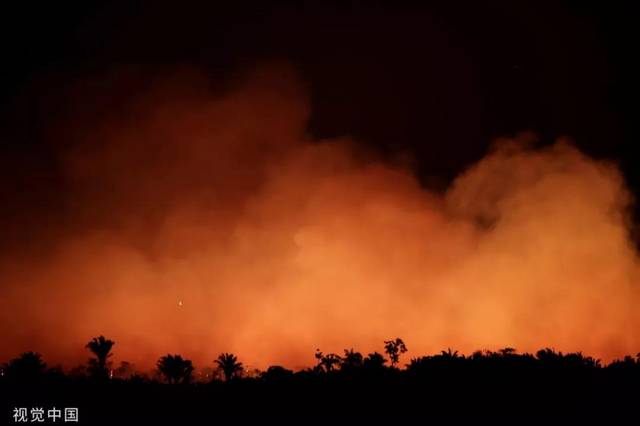
The fires did not stay inside Brazil. They spread into eastern Bolivia, where part of the Amazon rainforest also burned. At least 1 million hectares were affected there. Bolivia's government said on August 22 that fires in the Chiquitania region of Santa Cruz department had destroyed 700,000 hectares of forest and grassland and affected at least 1,817 families.
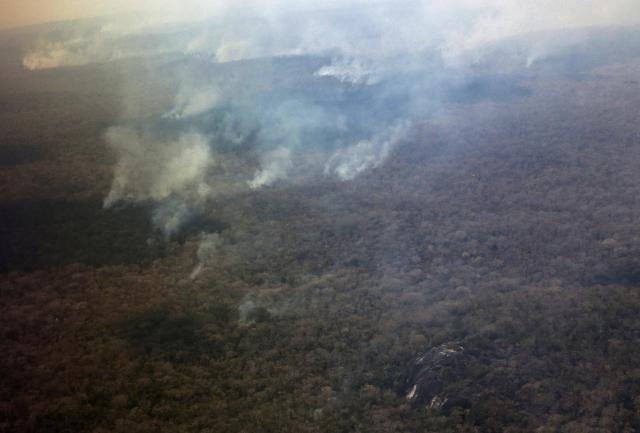
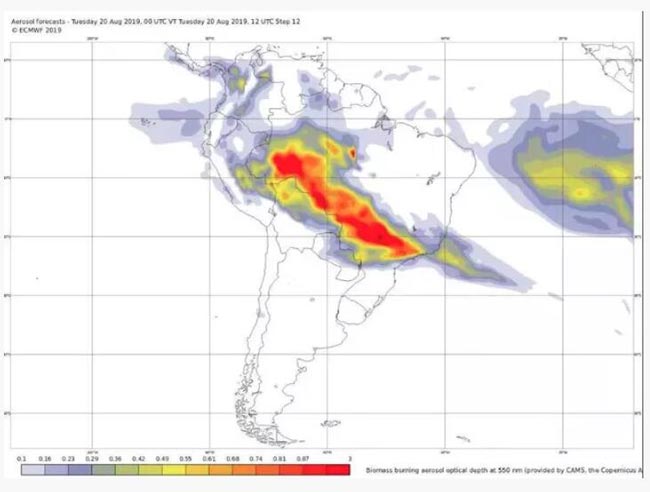
The Amazon is often called the planet's lungs. It produces about 20 percent of the world's oxygen and holds roughly 10 percent of its species. It is also being damaged by fire and by human activity. Around 15 to 17 percent of the forest had already been lost. Scientists warn that if destruction reaches 20 to 25 percent, the rainforest may no longer be able to maintain its own ecology and could degrade into tropical savanna. That would be catastrophic for Brazil and for the rest of the world.
Forest loss reduces the land's capacity to hold water, making dry seasons drier across the Americas. It also weakens the forest's ability to produce oxygen and absorb carbon dioxide. More carbon dioxide means a stronger greenhouse effect, higher temperatures, and a greater chance of forest fires elsewhere. The result is a vicious cycle.
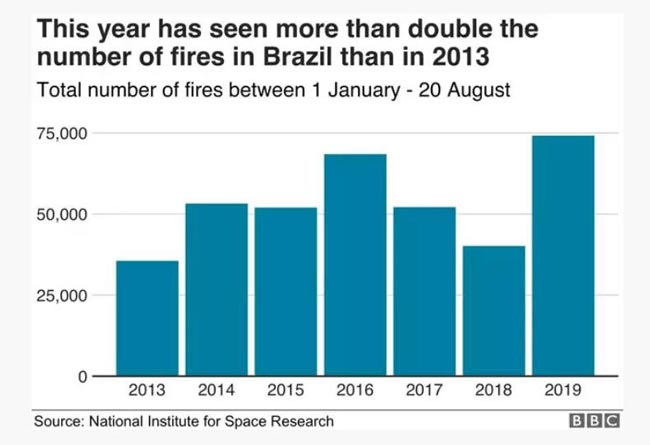
In Brazil, forest fires are a regular feature of the dry season. They usually begin in July and August, peak in September, weaken in October, and die out in November. That is the natural pattern. The number of fires in a given year is also closely tied to temperature and rainfall. In 2016, a strong El Niño brought higher temperatures and less rain, and Brazil recorded 67,790 fires, the highest number in recent years at that point.
But by late August 2019, Brazil had already recorded 72,843 fires since the start of the year, an increase of 83 percent over the same period in 2018. More than half were in the Amazon. This time, temperatures and rainfall were not abnormal.
So why were there so many fires? Brazilian media pointed to President Jair Bolsonaro. His governing approach favored clearing forest to speed up cattle ranching and mining, two industries that need large amounts of land. Much of that land is covered by forest.
According to Yale University's global forest map, 64 percent of the Amazon rainforest lies within Brazil. Deforestation began to climb in the 1980s as land was opened for cattle and soy. Between 1980 and 2004, Brazil lost an average of 20,000 square kilometers of forest each year, and roughly 20 percent of its woodland was lost over that period.
Deforestation peaked near 30,000 square kilometers in 2004. After that, the Brazilian government began using environmental policy to limit clearing. Data from PRODES, a government monitoring program, showed deforestation falling sharply from 2005. By 2009 it was below 10,000 square kilometers a year and remained there through 2017.
Over the previous decade, successive governments had curbed deforestation by coordinating federal agencies and imposing fines. After Bolsonaro took office in January 2019, he began pushing a set of policies that put development before protection. His government reduced fines for deforestation and weakened the influence of environmental agencies, effectively tolerating more destruction.
Brazil's National Institute for Space Research, known as INPE, concluded that the surge in fires was closely linked to increasingly intensive development. The Washington Post reported that INPE found farmers using fire to clear land, with flames spreading into intact rainforest so they could open more land. The cleared forest is usually used for cattle or soy, and much of the clearing is illegal. Weisse of Global Forest Watch also said that, so far, most fires appeared to be burning on land that had already been cleared for farming.
INPE also found that deforestation in the Amazon had risen sharply in 2019. Since January, 1,330 square miles of rainforest had disappeared, 40 percent more than in 2018. That infuriated Bolsonaro, who wanted to expand development in the Amazon. He fired INPE's director, the physicist Galvão.
Most of Brazil's tens of thousands of fires each year are not spontaneous. Ranchers and mining or industrial operators set them deliberately to clear land. Such planned burning is usually timed so that the rainy season arrives just as the fire is finishing its work. In 2019, however, the fires came earlier and burned on a larger scale. They escaped control and became a disaster for all of humanity.
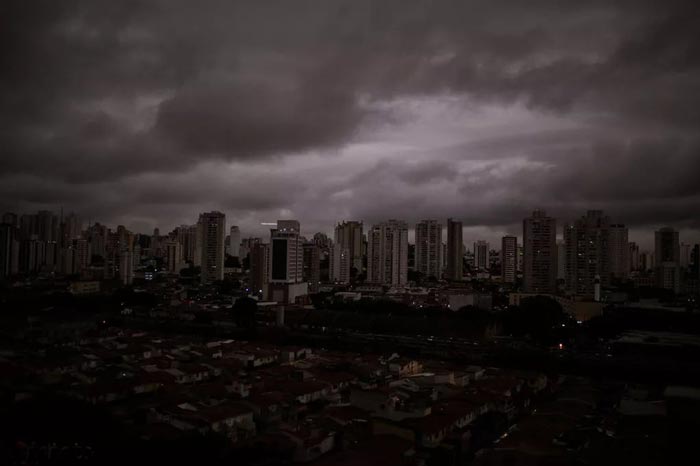
In São Paulo, smoke from the fires darkened the sky, and rain fell black. Daytime looked like night. Poor air quality can cause a range of respiratory illnesses. When the fires began to affect city residents, criticism of Bolsonaro's policies grew sharper.
Public anger over his tolerance of forest destruction by farmers, ranchers, and mining operators was matched by another controversy: Bolsonaro rejected a G7 aid package proposed by French President Emmanuel Macron at the G7 summit. Bolsonaro said the G7 had discussed helping Brazil fight the fires without inviting Brazil to take part, calling it a mistaken colonial mentality. Many Brazilians found that hard to understand. The G7 offer was for money and equipment; Brazil would still lead the firefighting plan. Bolivia, by contrast, welcomed foreign countries and organizations into its firefighting efforts, because it lacked essential equipment such as large firefighting aircraft, just as Brazil did.
Bolsonaro's tolerance of land clearing, his slow initial response, and his rejection of international help pushed public criticism to a peak once the fires were out of control. But Bolsonaro tried to shift blame to environmental NGOs.
The Guardian reported on August 21 that Bolsonaro told a steel industry conference in the capital that, in his view, the Amazon fires might have been set by non-governmental organizations because they were losing money. Why? To bring trouble to Brazil, he said. Earlier that day he said some people had gone out with cameras to start fires so they could film them. When asked whether he had evidence or could name the NGOs involved, Bolsonaro said it was only his feeling. Maybe, he said, he was not sure, these NGO workers were taking criminal action to draw attention and oppose the Brazilian government.
That response suggested Bolsonaro had run out of arguments. The explanation was so thin that even he might not have believed it. But it fit his political thinking: economic development comes before environmental protection, and rainforest destruction can be tolerated in the name of growth.
Many less developed countries have made the same choice between production and ecology. Indonesia has the world's third-largest tropical rainforest, but in 2012 it cut twice as much primary forest as Brazil for logging and pulp production. Bangladesh cut 90 percent of its primary forest for logging and farming. Canada's boreal forest covers 5.8 million of the country's 9.9 million square kilometers, but nearly half of it has been damaged.
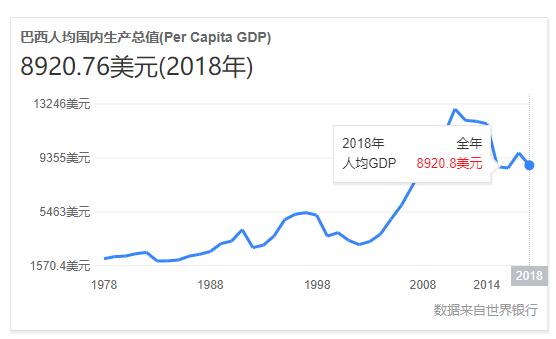
Brazil is a developing country with relatively low national income, and its per capita GDP had been falling since reaching 13,245.6 dollars in 2011. Reviving the economy was the government's top priority. Developing agriculture, cattle ranching, and mining was the fastest route, so Bolsonaro took it. From a global perspective, his approach was clearly wrong: the gains are temporary, while the costs are long-term. From Brazil's position, or from the position of Brazilian farmers, ranchers, and mining operators, his policies may look right because they can quickly stimulate growth.
Human beings tend to choose the outcome that benefits them most. Such choices are not always a matter of right and wrong.
China went through something similar. In the 1950s and 1960s, large areas of forest were cut down without planning. In the 1980s and 1990s, rough development and industries such as pulp and wood processing destroyed more primary forest. No one can say exactly how much forest was lost. By the late 1990s, ecological decline was obvious: sandstorms, mudslides, soil erosion, and desertification had become urgent problems, and the state launched enormous tree-planting campaigns. There is no reliable data on the cost of cutting versus replanting, and it may be impossible to calculate. But the cost of restoration was certainly far higher than the gains from logging, and China also had to bear the consequences of ecological degradation.
Brazil and other countries are in a situation similar to China's in the 1980s and 1990s. They damage ecology for economic growth, and later, after incomes rise and public environmental awareness awakens, they try to restore what was lost. But that back-and-forth wastes enormous wealth and leaves wounds that ecology cannot fully recover from.
Looking at human history, civilization has advanced while ecology has retreated. As civilization grows, so does the human population, and so does the range of human activity. More land is needed, and that need conflicts with forests and other ecosystems.
An old Chinese line says that when the mountains were stripped bare, the great palace could be built. Emperor Qin Shi Huang built the Epang Palace, and the mountains of Shu were left bald. The Yuan, Ming, and Qing dynasties built Beijing. In the early Yuan period, Beijing was surrounded by forests, rivers, and wetlands, with a climate similar to today's Zhejiang and Fujian. Emperor Jiajing of the Ming dynasty remarked after visiting Xiangshan that among the western mountains, only this one still had green. By the late Qing, the primary forests in the mountains north and west of Beijing had been almost entirely cut.
At the dawn of civilization, the world had 76 million square kilometers of primary forest, covering two-thirds of the land. By the mid-19th century, that had fallen to 56 million square kilometers. By 1975 it was down to 26 million square kilometers, with forest cover around 20 percent. By 2017, primary forest had shrunk to 11.6 million square kilometers. The world still loses about 90,000 square kilometers of primary forest every year. In these figures, primary forest means a continuous block larger than 500 square kilometers; fragmented patches are not counted.
Cities will inevitably take up space that once belonged to primary forest. What is frightening now is that cities are everywhere, and everyone wants a better quality of life. How can ecology be protected under those conditions?
The story told in the film 2012 may eventually come true, because humanity cannot control its own population growth or suppress its material desires. Unlimited demands on nature seem unavoidable.
The Amazon fires became a major topic, but similar events in Indonesia, Bangladesh, Russia, Canada, and even China have received far less attention.
To improve ecology, protect it, and even restore it, all of humanity needs to work together to control population and reduce unnecessary waste, such as paper and disposable tableware. It is unfair to blame large ecological countries alone for the damage they cause. They still have large ecological resources partly because they destroyed less in the past. What they destroy now may be meeting material demand from other countries.
The United States cut two-thirds of its primary forest between the 17th century and the 1930s. Only 15 percent remains. Yet the United States is also the country with the highest per capita resource consumption and one of the most vocal critics of other countries' environmental records.