An Employment Pass, or EP, is Singapore’s work pass for foreign professionals. The self-employed version is not a separate pass category. A person registers a Singapore company, becomes its employee or owner, and applies for an EP through that company. The purpose is to run a real business and, at the same time, hold legal work and residence status in Singapore. The applicant still has to demonstrate genuine business operations and meet salary and eligibility requirements.
The EP issued through your own company is identical to an EP obtained through an outside employer. There is no difference in status and no ranking between the two.
Who tends to use this route
-
Entrepreneurs with a business reason to enter Singapore or Southeast Asia. They may want to use Singapore as a strategic base for regional or global expansion, set up a branch or independent company, and take advantage of the business environment, tax regime, and international networks.
-
Companies expanding overseas that want a global or regional headquarters in Singapore. Firms in technology, internet, finance, trading, and other sectors often choose Singapore to strengthen international competitiveness, improve tax structures, and access global investment opportunities. The EP applicant is usually a senior executive, founder, or core team member who needs to manage the company’s affairs in Singapore.
-
Independent developers, freelancers, and digital nomads who want a company they can run remotely. Programmers, designers, consultants, marketing specialists, and similar professionals may use a Singapore company as the international business entity for receiving payments from global clients, while also benefiting from a stable tax and legal environment. Remote workers may use an EP to gain long-term residence in Singapore without giving up a flexible working style.
-
Investors and founders building an innovative or technology-focused business. They may plan to launch ventures in fintech, AI, blockchain, healthcare, education technology, or other cutting-edge fields, seeking government support or investor attention. Some aim at Singapore government startup support schemes such as Startup SG or technology innovation funds.
-
People who want to live in Singapore long term and value a stable business environment and high quality of life. This is the main group. Individuals or families may use entrepreneurship to obtain a long-term work pass, then seek permanent residence and access to education, healthcare, and the living environment. They typically set up a Singapore company and build a business in areas such as finance, cross-border e-commerce, international trade, technology and internet, media and entertainment, or professional services, based on their own expertise and market demand. The business has to fit EP approval requirements.
Applicants should make sure the company has real operations, a reasonable salary structure, and compliant business activity. These points matter for the success of an EP application.
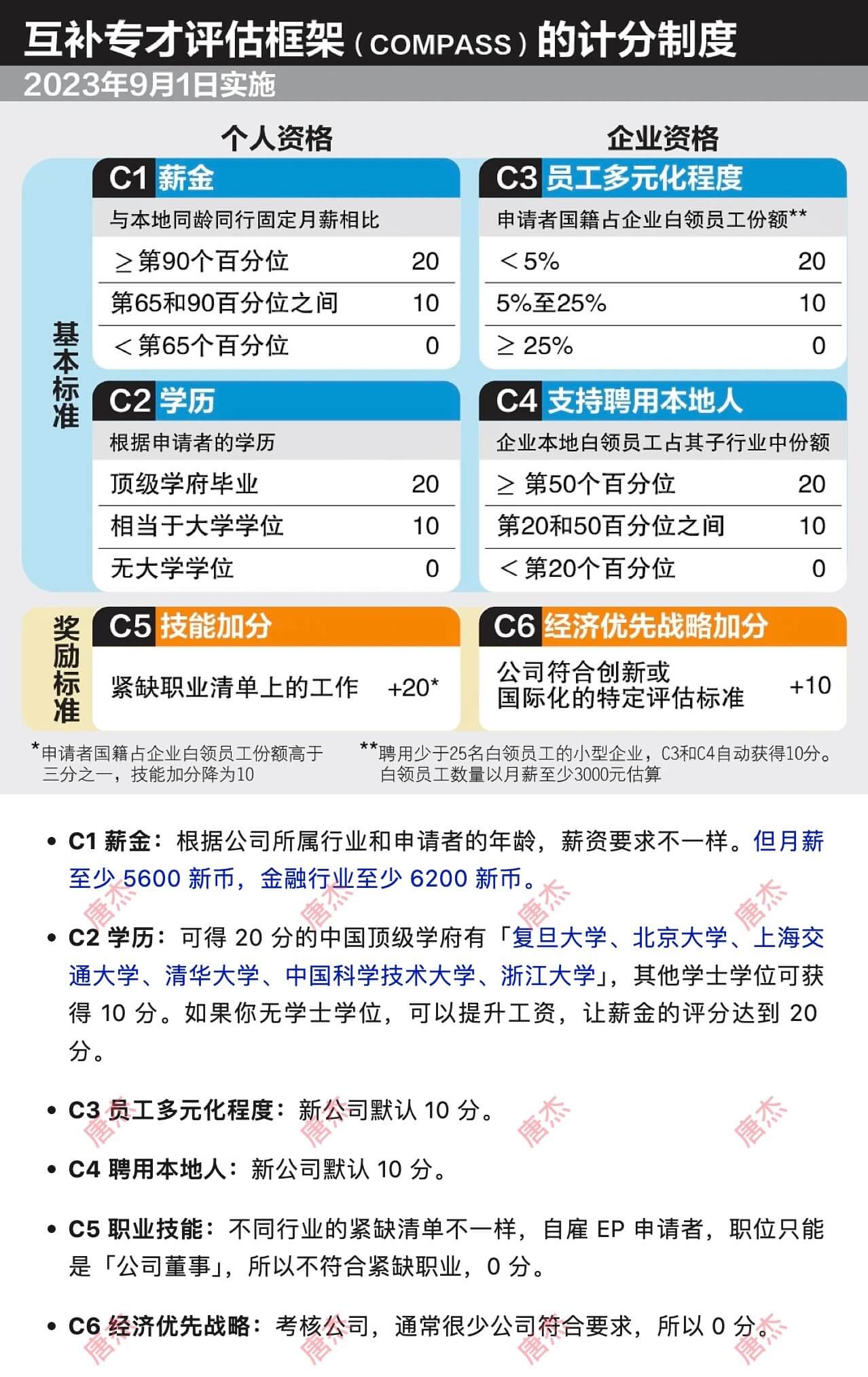
Singapore is a city-state with limited internal resources, so its development depends on globalisation and on foreign investment and workers. The EP exists for foreigners who come to work in Singapore, including company owners; they too are considered to be working in Singapore under an employment pass. There is no quota for EP. The Ministry of Manpower (MOM) issues it, and the application needs to reach 40 points under the COMPASS assessment framework.
An EP can be part of an immigration path, but it is not immigration by itself. The next step is to apply for permanent residence (PR), and after that, citizenship (SC). Only then is the immigration process complete.