D2 is familiar to many front-end engineers, yet not everyone who attends it can immediately explain what it represents. At first glance, it is simply a large gathering where front-end developers exchange technical ideas. More precisely, D2 is short for the D2 Front-End Technology Forum, whose English name is Designer < Developer Frontend Technology Forum.
The forum was initiated by Taobao. Each edition is organized by the D2 organizing committee, while hosting duties rotate among different companies. Its principles are built around three ideas:
- Designer + Developer: bringing creative and technical thinking together so that the two sides can produce more possibilities through interaction.
- Business practice: staying close to real work and helping products and businesses achieve better results.
- Openness: treating ideas and projects as something to share rather than keep private.
Its discussions cover the application of front-end technology in Internet products, practical development cases, and the broader direction of the front-end industry. In the long run, D2 aims to create a platform for professional exchange, help guide and standardize the industry, and influence the development of front-end technology.
This edition was hosted by Alibaba and attracted more than a thousand participants. It was a major gathering for the front-end community, with engineers from many companies meeting in one place and exchanging ideas across a wide range of subjects. The event itself was only part of the story; the conversations and connections that continued afterward were just as important.
A thousand people in one front-end community
The event took place on a Saturday, and the registration records listed 1,067 attendees: 884 men and 183 women. More than 118 people joined the evening reception. Most participants worked in front-end development, although a small number were still students who had not yet graduated.
D2 placed only one notable requirement on applicants. They had to fork a project on GitHub and submit a pull request, including a link to a personal blog, Weibo account, or similar profile. This gave the organizers a basic way to understand who was applying, and the screening mechanism was both simple and appropriate for a technical community.
Representatives came from many major companies, but a large proportion of the audience traveled to Hangzhou independently. The gathering brought together online acquaintances, classmates, colleagues, and friends who had previously known one another through the front-end community. Once everyone was in the same venue, it became clear how small and closely connected the community still was.
There were two conference rooms. The main hall could hold roughly 800 to 900 people, while the second room accommodated a little more than 100. The first talk in the smaller room attracted two or three hundred people and quickly filled the space. After that, many attendees simply stayed in the main hall, leaving the later sessions in the second room noticeably quieter.
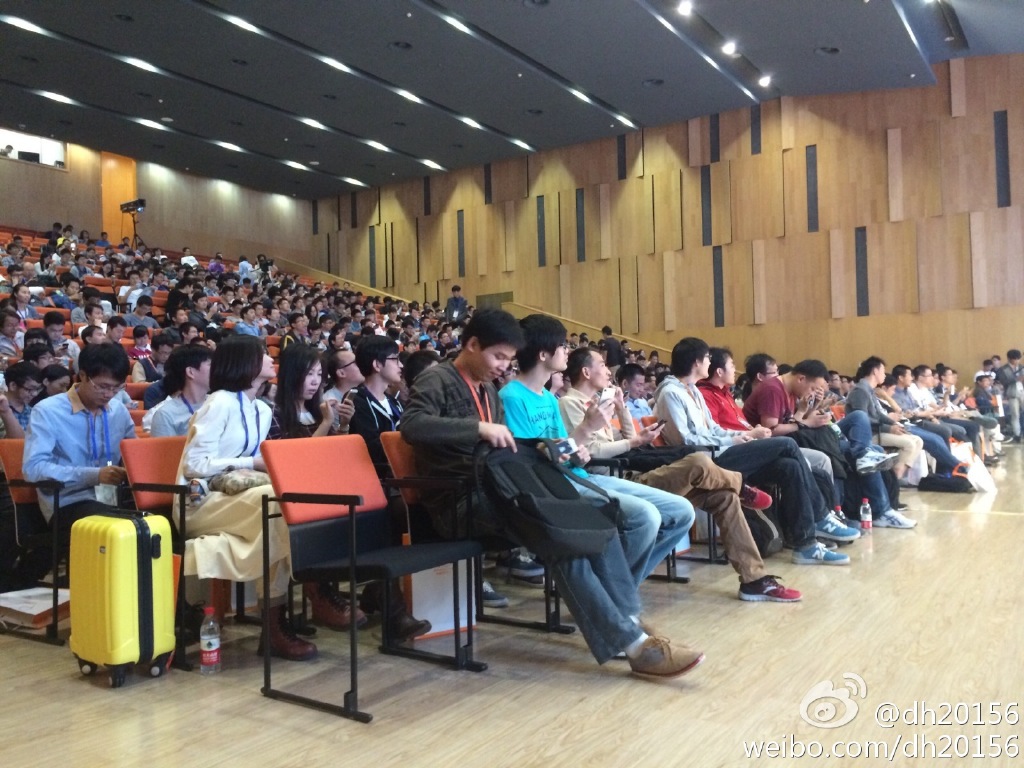
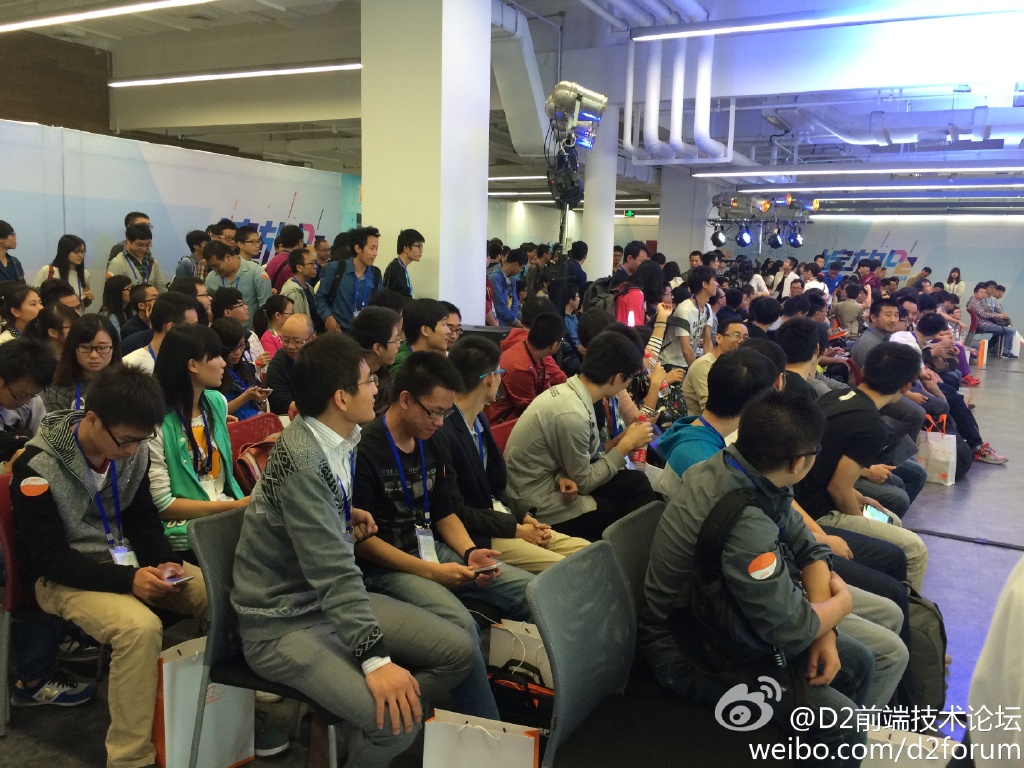
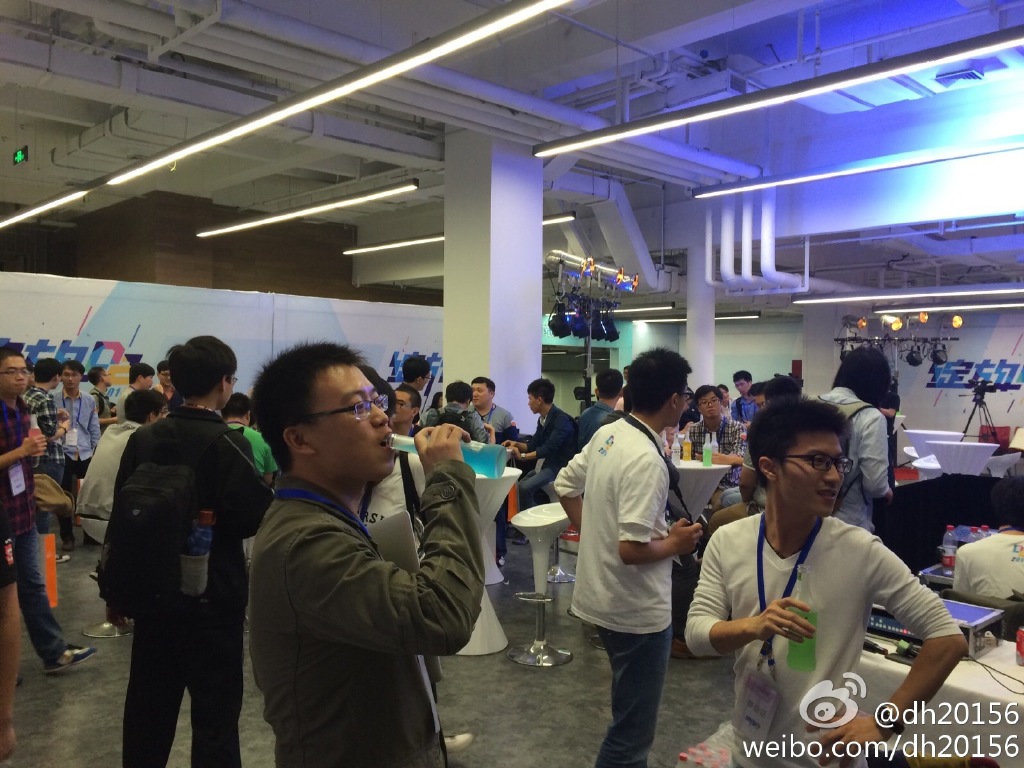
A thousand-person conference is difficult to run, but a clear theme, a well-made plan, an orderly schedule, and solid execution can make the whole experience enjoyable. That description fits the event well. The venue was lively, and the energy did not disappear when the formal sessions ended. Informal conversations, hallway meetings, and the evening reception extended the event far beyond the talks themselves.
What the program said about front-end engineering
The edition included the following presentations:
- Data at Your Fingertips
- Reflections and Practice on Separating Alipay’s Front End and Back End
- A Small Step for Node.js, a Giant Step for Front-End Development
- Listen to the Buzz of Angular.JS
- Front-End Practices for Third-Party Development
- Alibaba’s Practice with Enterprise-Level NPM Services
- Mogujie’s Multi-Platform Front-End Architecture
- The Development of an H5 Technology System for Mobile Travel Services
- JD.com’s Path Toward Front-End Industrialization
- Taobao’s Front-End Engineering and Automation System
- The Future of JavaScript Through the Lens of ES6
- Architecture and IBM Front-End Development
- Douban’s Approach to Front-End Development
Three or four dozen topics had reportedly been submitted for consideration, and the final program was selected after careful review by experienced front-end specialists. Even a quick look at the titles reveals several recurring words: data, architecture, systems, practice, development, Node.js, and engineering.
That vocabulary is significant. Front-end development was already moving beyond the early stage of focusing on isolated techniques and individual knowledge points. The central questions were increasingly about engineering practice, architecture, automation, and the construction of systems that could support growing products. As Internet companies expanded, this shift was becoming unavoidable.
Node.js was also opening up server-side territory for front-end engineers. Some people viewed that as front-end developers taking work away from back-end engineers, but that interpretation missed the more important change. Used as a middle layer between the front end and back end, Node.js could clarify the responsibilities of each side and provide a cleaner way to organize web applications. The absence of a presentation on fibjs was nevertheless a small disappointment for attendees who had expected it.
The expansion of Internet businesses created another pressure. Companies were broadening from a single product or service into multiple directions, and new requirements could no longer be met simply by hiring more engineers. The technology and the way teams worked had to evolve with the business.
Mobile development had arrived before everyone was ready
Among the sessions, Data at Your Fingertips, presented by Zhang Kejing of Baidu FEX, stood out for its focus on the details of mobile interaction. The title sounded literary, but the subject was highly practical.
The rapid rise of mobile Internet had caught many front-end engineers off guard. On a mobile device, people explore the world through the touch of a finger, and the details of that interaction affect how information is understood and presented. The talk examined the relationship between touch behavior, data, and the way information appears on mobile terminals before returning to several concrete engineering problems:
- device adaptation;
- mobile performance;
- technology frameworks;
- and other related challenges.
These were already some of the most difficult problems in mobile development, and they remained areas worth investigating for every front-end engineer. The gap between domestic and overseas mobile Internet practice could also be felt in actual project work. The underlying technologies were available in both places, but the domestic mobile ecosystem was still at an early, rapidly developing stage—full of experimentation and potential, but not yet fully mature.
A changing language and a broader web
ECMAScript 6 had its critics. Some developers felt that it made JavaScript unnecessarily complicated, or that it was turning the language into something increasingly similar to Ruby, Python, or Java. But the growth of a programming language is not merely a matter of adding features for their own sake. New capabilities usually reflect the demands of the market and the problems developers need to solve.
In that sense, the D2 program was well aligned with the direction represented by ES6. Modules, asynchronous programming, and more structured language features all supported the broader movement toward larger and more maintainable front-end systems.
The HTML5 specification had taken eight years to complete and had recently been declared finished at the time of the event. Web development appeared to be entering a more stable phase, but stability did not mean that the major questions had disappeared. The next stage still needed to address issues such as:
- information security;
- real-time communication;
- application development;
- and other problems that would become increasingly important as the web moved closer to the capabilities of traditional applications.
What mattered most about D2
Mobile topics deserved more room
Mobile Internet was already a major subject, and a substantial portion of Alibaba’s traffic reportedly came from mobile terminals. Against that background, the program contained relatively little dedicated discussion of mobile technology. Future editions would benefit from giving mobile architecture, performance, interaction, and cross-device development a larger place.
The talks were not the entire point
Attending a conference is not only about sitting through every presentation. The value of a talk depends on both the speaker’s ability to communicate and the depth of the speaker’s research. Few presenters are equally strong in both areas, and the audience is rarely composed entirely of senior engineers. Some technically valuable material is simply difficult to absorb in a single session.
D2’s stated goals were to build an industry platform, guide and regulate the development of the field, and influence the direction of front-end technology. In practical terms, one of its greatest benefits was more direct: meeting people who could later discuss a difficult problem, compare approaches, or offer a different perspective.
Accessibility should be part of technical progress
In addition to the main conference rooms, the event included several themed areas. One of them focused on accessibility. As technology is expected to serve people equally, front-end development should pay more attention to users with disabilities and other groups whose needs are often overlooked.
Alibaba had established an accessibility interest group that worked in its spare time on improving the accessibility of Alibaba’s pages and promoting awareness of the issue. More companies joining this effort would make products easier to use and help accessibility become a normal part of product development rather than an afterthought.
D2 was therefore more than a series of presentations. It reflected a front-end community moving from isolated techniques toward engineering systems, business practice, mobile platforms, and broader social responsibility. The next edition would have plenty of room to continue that conversation.