Over the past few years, Chinese internet culture has produced a cluster of highly recognizable labels: tangping (lying flat), huangmao (yellow hair), beng laotou, jingshen xiaohuo (spirit guys), and jingshen xiaomei (spirit girls). They look scattered and unrelated, but they fit together like pieces of a puzzle, forming a portrait of how young people in China are navigating a difficult present. These labels are not simply personal choices. They are collective emotional outlets that emerge when a generation runs into structural limits.
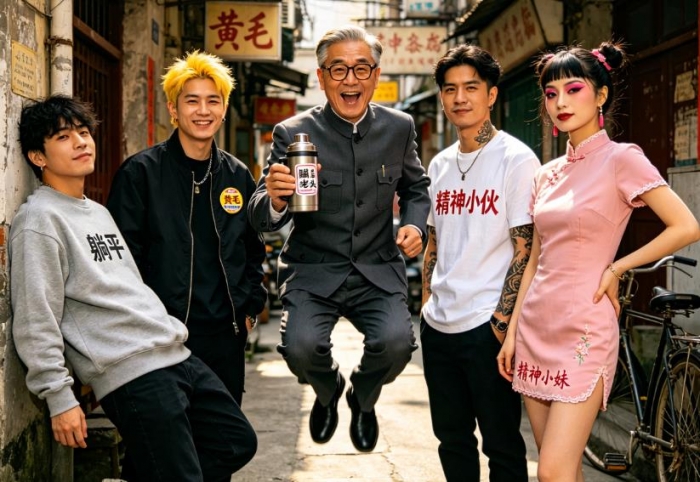
Tangping was the first of these terms to break out of its niche. It describes a survival strategy of deliberately lowering desire: no mortgage, no rushed marriage, no pressure to have children, no surrender to meaningless overtime, and a minimum standard of living maintained at the lowest possible cost. On the surface it looks like passive noncooperation. In practice it is a rational calculation made under three pressures: high housing prices, a strained job market, and slowing income growth. When someone clearly sees that no amount of exhaustion will cross the class barrier, and that even the stable, step-by-step life their parents describe is out of reach, lying flat is not an excuse for laziness. It is a timely stop-loss measure, a form of self-protection. In 2023, the number of college graduates reached 11.58 million, and youth unemployment at one point passed 21 percent. The issue is not that young people refuse to work hard. It is that the return on hard work, the sense that effort can be exchanged for a decent life, is falling fast.
If lying flat is a quiet strategic retreat, huangmao is a loud, marginal act of deviation. The term originally referred to low-income young people on the edges of cities who dyed their hair bright yellow. It has since become a cultural symbol: cheap trendy clothes, modified electric bikes, blunt social maxims recited on short-video platforms, and the noisiest possible way of announcing one's existence. Most people in this group have limited education and run into walls when trying to integrate into city life. Formal employment is especially narrow for them. They cannot afford to lie flat, and they cannot find a ladder upward, so they choose the most conspicuous posture available. They appear in internet cafes, pool halls, and late-night food stalls in fourth- and fifth-tier cities. They are the gravel washed ashore by urbanization, unwilling to disappear quietly, using the most glaring color to mark a place for themselves on the ground.
Beng laotou entered public view more recently. The label refers to middle-aged men, mostly born in the 1980s and 1990s, who send red envelopes or small financial support to young women, often jingshen xiaomei. They know the other person's enthusiasm may be a scripted routine, yet they willingly ask to be played. Behind this absurd mutual pursuit lies the emotional barrenness of middle age: the grinding pressure of family, career plateaus, shrinking social circles. These men buy a few moments of attention in the virtual world. Even when that attention has a price tag, they are willing to pay for the emotional value of the moment. From the rebellious visibility of huangmao to the humble compromise of beng laotou, a complete emotional chain becomes visible. Some young people, with nowhere to go, perform in exchange for survival resources. Some middle-aged people, emotionally hollow, pay for that performance. Two groups disappointed by reality offer each other a tacit consolation in hidden corners of the internet.
Jingshen xiaohuo and jingshen xiaomei bring this subcultural vocabulary together. Jingshen xiaohuo usually refers to small-town young men obsessed with a tough-guy persona: bean shoes, tight pants, and rhythm-heavy social shake dancing. Jingshen xiaomei is the female counterpart, active on livestreaming platforms, using polished beauty filters and direct, sweet talk to harvest traffic and tips. Both groups share a practical survival logic: fast money above all, looks as justice, traffic as success. It is more accurate to say that the limited options available in society shaped their choices than to say they simply chose this path. When young people see the probability of study changing fate growing blurrier, while livestreaming, influencer work, and traffic-driven routes can bring quick returns, choosing those routes is a realistic calculation. This is not simple moral decline. It is a survival pragmatism that has been worn into shape by reality.
Seen together, these scattered phenomena share a deeper social root: narrowing class mobility. As the upward channel becomes crowded and narrow, some people exit the game of intense competition by lying flat. Some look for paths outside the rules, as huangmao and jingshen xiaohuo do. Others become consumers of other people's emotional value, as beng laotou do. This is not the moral decline of a particular generation. It is a structural problem casting its shadow on ordinary individuals.
For four decades, China went through the largest urbanization process and fastest economic growth in human history. The previous generation believed that effort would bring success because that proposition was repeatedly confirmed in an era of rapid expansion. Today's young people face a very different era, one of competition over existing stock. The housing price-to-income ratio is among the highest in the world, 996 work schedules are common in many industries, degrees are losing value quickly, and class boundaries are hardening. When the promise that hard work brings reward fails again and again, young people naturally look for alternatives. Lying flat is an economic alternative. Huangmao is an alternative at the level of identity. Beng laotou is an alternative at the level of emotional need.
Of course, blaming external conditions for everything is also unfair. Individuals always have room to choose. But before rushing to discuss personal responsibility, society should reflect on the competition track it has built. When graduates of 985 universities are delivering food to make a living, when a master's degree is only a baseline for entry-level hiring, when an ordinary family must empty the wallets of three generations to cover the down payment on an apartment, empty talk about struggle changing everything sounds detached from the ground people are standing on.
Every marginal subculture that rises is, at bottom, a silent collective statement. Behind labels like lying flat, yellow hair, beng laotou, spirit guys, and spirit girls, labels that look chaotic, negative, and even a little ridiculous, is a generation struggling to find its place in the current of the times. Rather than stand above them and mock or scold, it is worth stopping to ask a serious question: how much room has this rapidly advancing society actually left for ordinary young people to choose their lives with composure?