1
In early May 2023, I traveled for work to a high-altitude county in western Sichuan. Strictly speaking, I should have gone there as early as 2021. But in both 2021 and 2022, the trip never happened. At the time, crossing an unclear and constantly shifting pandemic-control boundary could mean losing one’s job and reputation overnight. The line existed, but no one could say exactly where it was.
So the work that should have been done kept being postponed.
By May 2023, I heard that some colleagues were preparing to visit another plateau county in western Sichuan. I made a last-minute decision to go with them and took the vehicle they had rented. They stayed one night in the county where I was working, along with the driver, and left for their own destination the next day.
The previous winter, when I went to the traditional Chinese medicine department of a hospital to get medicine for general conditioning, I mentioned that I would probably have to travel to the plateau the following year. I asked the doctor to prescribe something for altitude sickness. Although he practiced Chinese medicine, he could also prescribe Western medicine and order examinations such as CT scans and color Doppler ultrasound; it was just that his own diagnostic method did not depend on those tests.
This doctor, who had inherited his medical knowledge through his family, prescribed two medicines for me: Compound Danshen Dripping Pills and Tongxinluo Capsules. Later, these two medicines would play an important role in reducing the burden on my heart.
2
Before writing about how my heart began to go wrong this time, I need to briefly mention an earlier experience with heart disease from childhood. My memory of that period is incomplete, so I can only describe what I still remember.
Around 2001, I developed pulmonary heart disease. At first, it did not cause any obvious impairment in daily life. The symptoms became noticeable only after strenuous exercise. My parents did not treat the illness with much seriousness. Because our family was extremely poor, we had developed a habit of avoiding medical tests whenever possible, and my father’s strong resistance kept me from undergoing proper instrumental examinations.
My mother, however, insisted on treating me. She took me to a traditional Chinese medicine clinic in town, where I was given medicine and acupuncture. The medicine was charged at cost, and the acupuncture was almost free. As the treatment continued, my lung condition improved. The heart disease did not fully recover, but it also stopped getting worse.
One day, my mother went to pick up medicine for me. I did not go for acupuncture that day. There she met a woman she did not know, someone from the city who was acquainted with the doctor, a practitioner surnamed Xia. When the woman saw my mother, she said, roughly: “Your family worships Guanyin Bodhisattva, holding willow leaves, right?” Then she looked at my mother’s left hand and said something like: “The man in your family is not tall, a bit plump, and full of illness. All the work at home falls on you. He can’t earn money and can’t do labor. Your child will still be ill for three more years. That is his fate. Nothing can be done.”
These are not the exact original words, but that was the meaning.
Before I started junior high school, my father took me to the hospital for an examination. The results showed sinus tachycardia and an irregular heart rhythm. A black-and-white B-ultrasound found no structural abnormality in the heart, so it was not congenital heart disease. My heart rate was over 120 beats per minute. The arrhythmia appeared as intermittent, regular pauses; on the electrocardiogram, the waveform and flat-line intervals formed a regular pattern.
During my three years of junior high school, we tried one doctor after another in a desperate way, but the heart problem never really resolved. Then, in the second semester of my first year of senior high school, the illness disappeared.
All these years, I have never known what caused the sinus tachycardia and arrhythmia, nor how they recovered. What happened was just as the strange woman my mother met had said: after a little more than three years, the illness was indeed gone.
Those years of heart disease left me with a habit of avoiding intense exercise. It was not a good habit, and it has stayed with me ever since.
3
Before the May 2023 work trip, I had undergone two physical examinations: one for employment and another the following year for teacher certification. Outside of those routine checkups, I had also had electrocardiograms, a cardiac color Doppler ultrasound, and CT scans. Several traditional Chinese medicine doctors had taken my pulse as well. None of these ever found any heart problem.
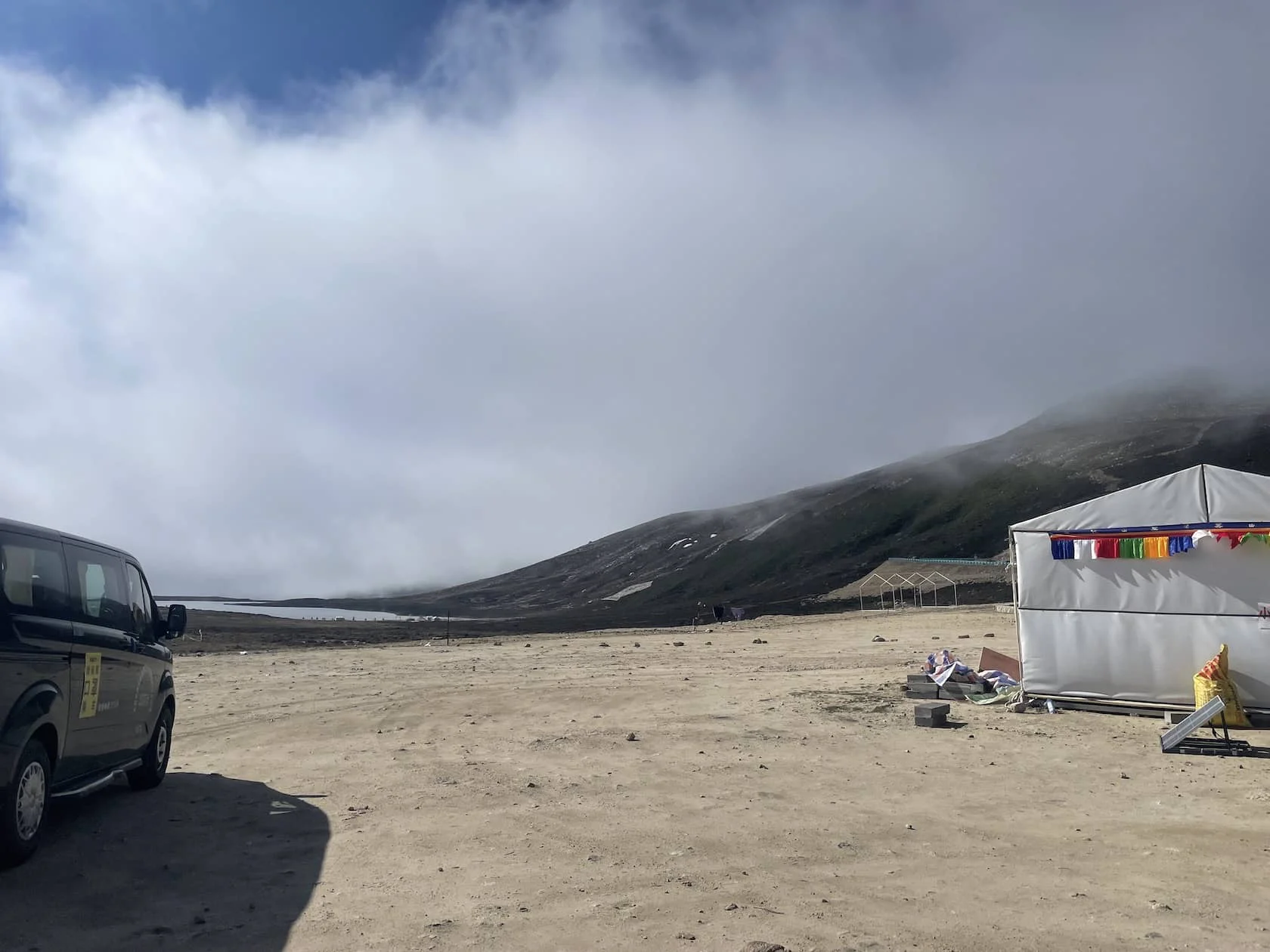
On the way to western Sichuan, once we passed Kangding, there was no more expressway and we had to take national roads. The elevation along the road climbed gradually. A few dozen kilometers west of the Kangding expressway toll station, one must cross Zheduo Mountain, the highest-elevation pass in Kangding. At that time, National Highway 318 was closed for repairs, so we took Provincial Highway 434 instead.
Near the Yala Mountain Pass, at about 4,400 meters above sea level, we got out of the vehicle and walked around. I could feel my body becoming light and unsteady. When I used the restroom there, I briefly lost awareness the moment I urinated. I realized that at such an altitude, even the slight exertion needed to urinate was enough to deprive the brain of oxygen and cause a short lapse in memory.
When I mentioned this to my colleagues, the driver said, “My wife once fainted straight away in the restroom here. Better not use the bathroom at this altitude.”
At that moment, however, I still naively believed that the high altitude would not cause any real harm to my body, so I did not take the medicine the doctor had prescribed.
We followed the provincial road past Kangding Airport, and the elevation gradually dropped to around 3,500 meters. It was not until the afternoon that the altitude climbed back above 4,000 meters. By the time we reached the destination in the evening, the elevation was around 3,950 meters.
While eating dinner with the people receiving me, I could feel a slight shortness of breath. Speaking took more effort than usual. Out of self-protection, I did not dare speak loudly, and I certainly did not dare run.
4
That first night after arriving, I sensed that something was wrong.
A little after ten o’clock, I prepared to sleep. The window was shut, the curtains were drawn, the lights were off, and my phone was set aside and used only rarely. I lay there until 1:30 in the morning without falling asleep, and without feeling the slightest sleepiness.
I understood then that the lack of oxygen was probably causing dysfunction of the autonomic nervous system, severely disrupting my sleep. At 2:30 a.m., I took the two medicines the doctor had given me. My thinking was that their heart-strengthening effect might improve blood circulation, reduce the oxygen shortage in my brain, and help me fall asleep.
That judgment turned out to be correct. About an hour later, I fell asleep. I slept for a little more than two hours that night and woke up three times. Around 5:40, after waking for the third time, I could not sleep again.
When I got up and opened the curtains, I saw that it was snowing outside. In a high-altitude region, under normal climate conditions, snow in May is not unusual. I had known it would be cold there, so I had brought a fleece-lined jacket and a thin pair of wool trousers. But after going out, I realized the cold was worse than I had expected.
The environment I grew up in made me more tolerant of cold than many people from Sichuan, so the low temperature did not stop me from doing any of my work.
But the cold brought an invisible injury that I had overlooked: severe oxygen deprivation. It would cause fairly serious damage to my body, and the illness it left me with has continued to this day.