I was late to this, as usual. Only today did I hear about a tool called the Zhuque AI Detection Assistant. The trigger was an article I came across about the 2025 'literary eight' who write with AI. Some of them, it claimed, had earned substantial manuscript fees, become recognizable writers, and joined various writers' associations and organizations.
Out of curiosity, I ran my own writing through Zhuque. Every piece came back with 'human characteristics significant,' marked 100% human-written. Maybe my rambling, diary-like stuff is too shallow and direct for AI; it can tell at a glance that a person wrote it.
Then I tested two writers mentioned in that article: Lin Haiping's The Vanishing Wheat Threshing Ground and Shi Chunxiang's Grandpa's Grid Paper. Both came back with 'no obvious human creative features' and were judged 100% AI-generated.
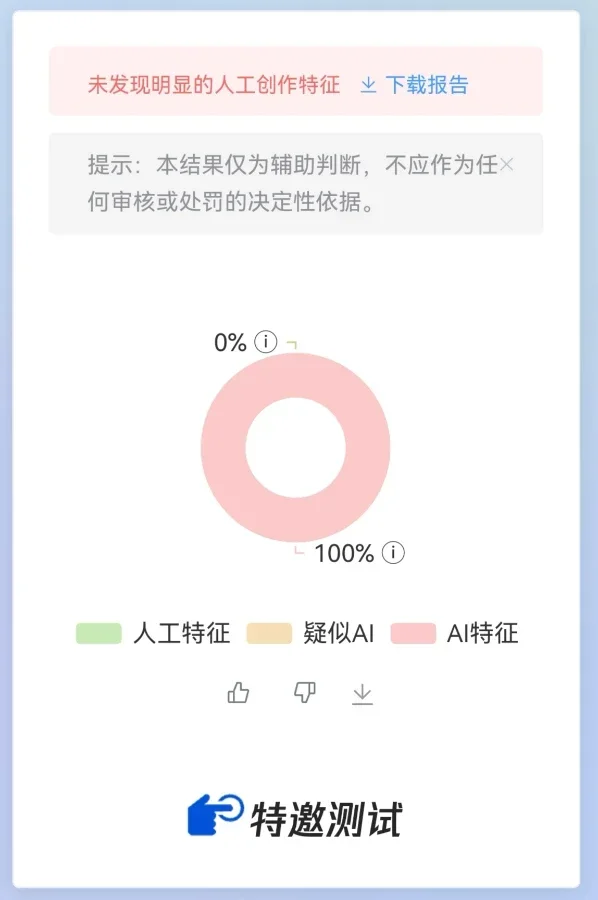
When I read Grandpa's Grid Paper, some passages did feel off. One went something like:
Grandpa's hands were covered with age spots. The old man's hands were a piece of dead wood, skinny and bony, yet they firmly held an old Hero pen. The nib scratched across the paper with a rustling sound, writing slowly, every stroke carrying effort.
The passage says 'Grandpa' and then immediately switches to 'the old man.' Who writes like that? And 'the old man's hands were a piece of dead wood' doesn't sound like something a person would say, either.
In another article, I saw chat logs from Lin Haiping. He said he was just playing around: in January 2024 he downloaded an AI program, wrote five or six essays a day, and then used software to send them out in bulk, which made publication much more likely. Ugh. I couldn't do that. Forget everything else—in front of relatives, friends, and colleagues who know me, I couldn't stand the embarrassment.